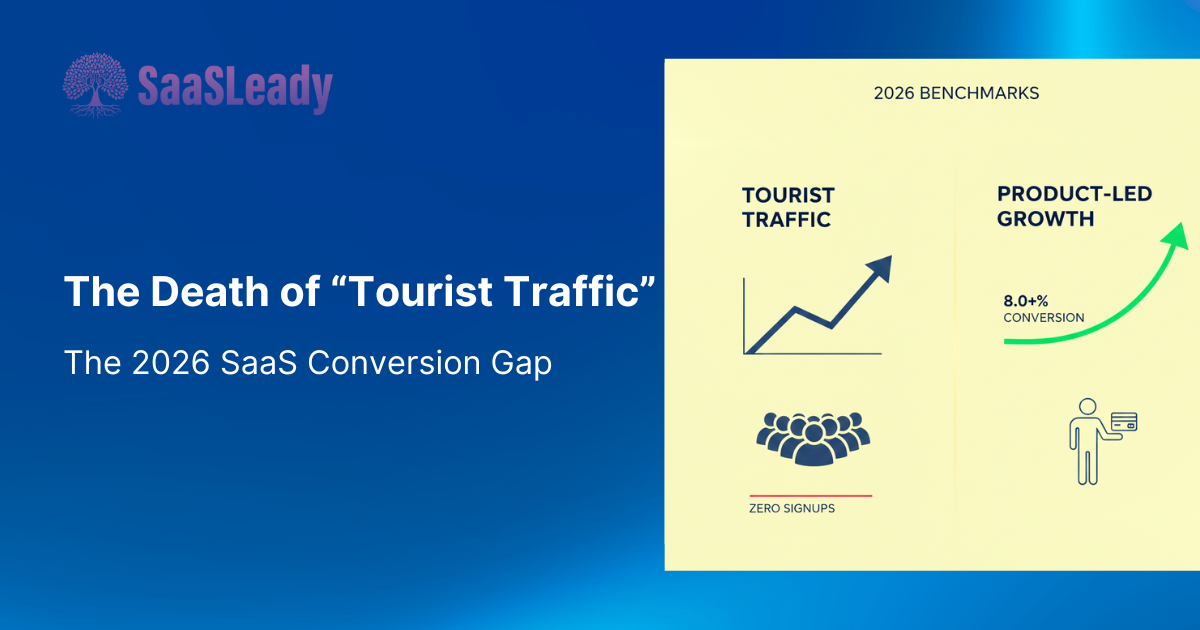
B2B SaaS companies lose millions in ARR by optimizing for “tourist traffic” instead of high-intent “Problem Solvers” looking for immediate activation. According to recent benchmarks, the gap between average (1.5%) and elite (8.0%+) conversion rates is driven by Product-Led Content, assets that serve as functional demonstrations of the product’s value (Pixelswithin, 2026).
The “Traffic-Signup Gap”: Why SEO Success Often Equals Business Failure
If organic traffic climbs while Monthly Recurring Revenue (MRR) remains flat, your content strategy likely suffers from a fundamental mismatch in user intent. Many teams still chase Top-of-Funnel (TOFU) volume, ranking for broad definitions like “what is project management.” While these drive sessions, they attract students and researchers, not buyers.
To bridge this gap, SaaS leaders are pivoting toward Bottom-of-Funnel (BOFU) clusters. Data indicates that content focused on “Alternatives to [Competitor]” or “How to automate [Specific Task]” can drive up to 5x more signups than generic educational content, even with 90% less traffic. In 2026, organic SEO visitor-to-lead rates top out at 2.1% for high-intent queries, whereas paid search often struggles at 0.7% (Pixelswithin, 2026).
The Distinction Between “Informational Seekers” and “Problem Solvers”
To scale revenue, you must shift your editorial focus from broad conceptual education to specific task execution. Today, buyer is “AI-first,” using tools like Gemini or Perplexity to find exact workflows.
- Informational Seekers: Search for “What is CRM?” (Conversion rate: <0.5%).
- Problem Solvers: Search for “How to sync HubSpot leads to Slack” (Conversion rate: 3.0%–5.0%).
Product-led content improves signup rates by embedding the product’s value proposition directly into the learning experience. You can optimize for vanity metrics, or you can optimize for the 2.45% median SEO conversion rate required to maintain a healthy CAC payback period in 2026 (Promodo, 2026).
The Three Killers of SaaS Content Conversion
Even high-quality content fails if it lacks a conversion-focused architecture, resulting in “leaky” funnels that drive up Customer Acquisition Costs (CAC).
- The “Ghost Product” Syndrome: Marketers often treat their product as a footnote. 81% of B2B buyers have already selected a preferred vendor before contacting sales (6sense, 2025). If you don’t show your tool as the solution, the buyer will find one that does.
- Targeting Generic Keywords over High-Intent Pain Points: Competing for “Marketing Strategy” puts you against Wikipedia. Win the “Decision Phase” with specific entity-based queries: “[Your Product] vs [Competitor]” or “Best [Competitor] Alternatives.”
- Misaligned CTA Friction: Asking for a 30-minute demo on a low-intent blog post is a high-friction mistake. Opt-in free trials (no credit card) convert visitors at 8.5%, whereas demo-led models often drop to 1.0%–2.0% (First Page Sage, 2026).
Product-Led Content: The Framework for Driving Signups
Successful SaaS content acts as a “silent salesperson” by allowing users to experience the product’s “Aha! moment” before the signup page.
Mapping Content to the “Activation Event”
Your content must lead directly to the feature that solves the user’s pain. If your software reduces data cleaning time, write about the “nightmare of messy spreadsheets” and use tools like Navattic or Arcade to embed an interactive demo. Time-to-first-value under 5 minutes can boost trial conversions above 25% (Klickflow, 2026).
Weaving Features into the Narrative
- Contextual Screenshots: Replace generic stock photos with your actual UI.
- Feature-Specific Subheads: Use headings like “Automating Outreach with [Product Name]” to assist AI engines in Subject-Predicate-Object extraction.
- Expert Insight: As B2B strategist Rosanna Campbell notes, “If your content is this good at solving problems, users assume your product is better.”
Benchmarking Your Content ROI: Beyond Pageviews
In 2026, traffic is a vanity metric; the only “North Star” for content is Content-Assisted Conversions.
Multi-touch attribution models in platforms like Usermaven or Google Analytics 4 now assign revenue value to middle-of-funnel content. High-performing SEO and blog content consistently deliver an average ROI of 702% for B2B SaaS (Averi.ai, 2026).
- Healthy Benchmark: Aim for a 1.5% to 3.0% visitor-to-signup rate on high-intent posts.
- The Risk: If your rate is below 0.5%, your content is likely too broad, or your site speed—which must be sub-2 seconds to avoid a 50% conversion drop—is failing you (Klickflow, 2026).
Implementation: 4 Steps to Audit and Fix Your Strategy
- Perform a High-Intent Audit: Use Ahrefs to identify pages with 1,000+ monthly visits but zero conversions. Rewrite these using the “Product-Led” framework.
- Prune “Dead-End” Articles: Remove low-intent content that dilutes your topical authority. Segmented sites see 28.2% higher organic traffic growth (Promodo, 2026).
- Build “Comparison” Hubs: Create transparent comparison pages to capture users at the highest point of intent.
- Optimize for AEO: Ensure articles contain clear factual statements. Use semantic triples (e.g., “[Product] automates [Task]“) to ensure LLMs cite your tool as the solution.
Next Step for Growth Teams: Stop chasing viral “thought leadership.” Look at your product’s most successful users, identify the first problem they solved, and write the definitive technical guide on how your product does it best.
Frequently Asked Questions
1. What is a “good” conversion rate for B2B SaaS blog content in 2026?
While homepages typically convert at 5%–10%, high-intent blog posts (BOFU) should aim for a 1.5% to 3.0% visitor-to-signup rate. If your blog is converting below 0.5%, you are likely attracting “Informational Seekers” rather than “Problem Solvers.”
2. Should I gate my product demos or keep them ungated?
In 2026, the trend has shifted toward ungated, interactive tours (using tools like Navattic or Arcade). Research shows that replacing “Request a Demo” forms with interactive tours can increase qualified leads by up to 127% because it respects the buyer’s desire for a self-educated, rep-free experience.
3. Why does my high-traffic content fail to drive signups?
The most common culprit is Search Intent Mismatch. You may be ranking for broad, educational terms (TOFU) that attract students or researchers. To drive revenue, you must pivot toward “Product-Led” keywords that mention specific tasks your software solves or compare you against competitors.
4. How long does it take to see an ROI from a content-led SEO strategy?
Most B2B SaaS companies see a meaningful impact on pipeline and revenue within 6 to 9 months. This timeline reflects the compounding nature of organic authority and the longer decision-making cycles typical of enterprise software.
5. How do I optimize my content to be cited by AI search engines like Perplexity or Gemini?
Focus on Answer Engine Optimization (AEO). This involves using “Answer-First” formatting (direct answers of 40-60 words at the start of sections), structured bullet lists, and “semantic triples” (Subject-Predicate-Object) that allow LLMs to easily extract your product as the solution to a specific problem.