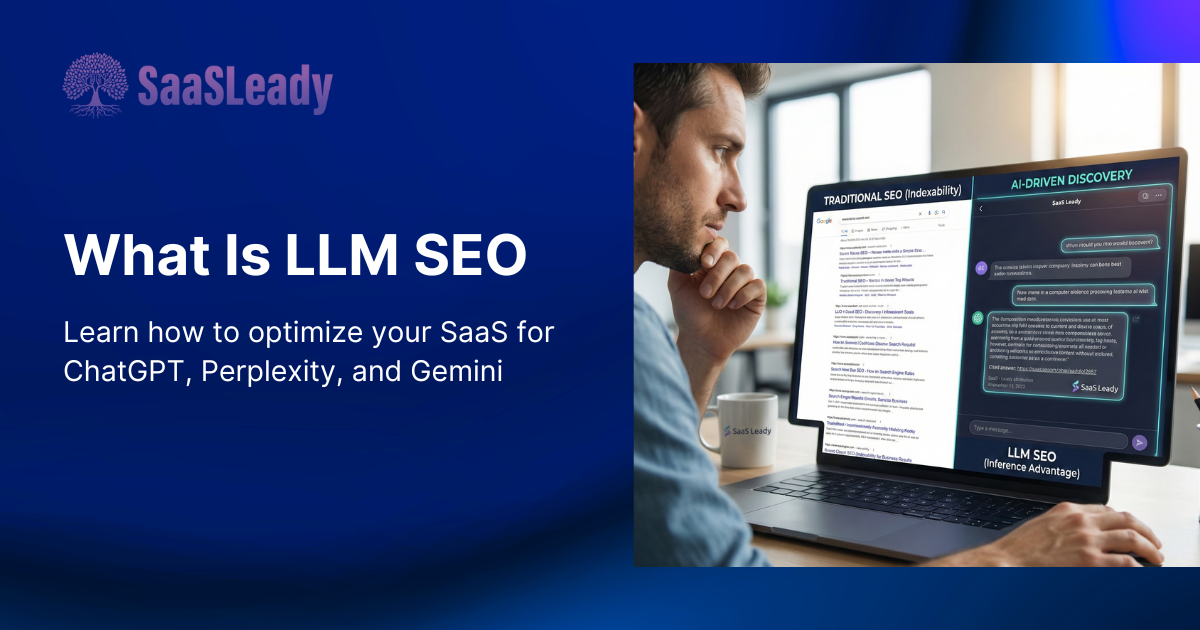
SaaS companies optimizing for Large Language Models (LLMs) see a 4.5x higher conversion rate from AI-driven discovery than traditional search. This is because AI answers act as “digital tour guides,” pre-qualifying leads by validating your product’s fit before they ever click a link to your site.
If you’ve spent the last decade fighting for the top spot on Google, the rules of the game just changed. We are moving from the era of “The Blue Link” to the era of “The Definitive Answer.” For a SaaS founder, this isn’t just a technical shift; it’s a fundamental change in how your software is discovered, evaluated, and bought.
Key Takeaways:
- The Shift: Success in 2026 isn’t about ranking #1 on Google; it’s about becoming the cited source in AI answers. Being a “recommended” product by an LLM drives higher conversion than a traditional search click.
- The Technical Core: LLMs prioritize “Semantic Triples” (Subject-Predicate-Object facts) and “Modular Snippets” (standalone paragraphs). If an AI can’t easily extract a clear fact from your page, you don’t exist in the answer.
- The Trust Factor: Backlinks are still useful, but “Entity Consensus” is the new gold standard. AI models verify your brand’s claims by looking at what people say about you on Reddit, G2, and niche industry forums.
- The Goal: Optimize for “Inference Advantage.” Make your product the most logical, unambiguous choice for the AI to recommend when a buyer asks a high-intent question.
The ROI of LLM SEO: Why AI Discovery Outperforms Search Rankings
In traditional SEO, your goal was traffic. You wanted thousands of people to land on your blog, hoping a small percentage would eventually sign up for a trial. But LLM SEO (often called Generative Engine Optimization or GEO) flips the script.
When a prospect asks Perplexity or ChatGPT, “What’s the best CRM for a PLG startup with a lean sales team?”, they aren’t looking for a list of ten links. They want a recommendation. If your SaaS is the one the AI describes, cites, and justifies, that prospect arrives at your site already 80% convinced.
From “Traffic” to “Citations”: Defining Success in 2026
For years, we obsessed over “Page 1.” In 2026, the only metric that truly moves the needle for a founder is LLM Share of Voice (SOV).
Think of it this way: In the old world, a backlink from a high-DR site was a vote of confidence for Google’s crawler. In the new world, a citation within an AI answer is a third-party endorsement for a human buyer. Being the “cited source” doesn’t just drive a click; it builds immediate authority. This shift significantly lowers your Customer Acquisition Cost (CAC) because the AI has already done the heavy lifting of mapping your features to the user’s specific pain points.
If ChatGPT tells a founder that your tool is the solution to their churn problem, that lead is worth ten “top of funnel” blog readers.
Strategic Choice: Traditional SEO vs. LLM SEO
Traditional SEO is built for indexability; LLM SEO is built for inference and trust.
If you’re still chasing 3,000-word “ultimate guides” just to satisfy a keyword density tool, you’re optimizing for a version of the internet that is rapidly shrinking. LLMs don’t care about your word count; they care about how easily they can extract a “ground truth” about your product to answer a user’s prompt.
| Feature | Traditional SEO (Search Engines) | LLM SEO (Generative Engines) |
| Primary Goal | Rank in the “Top 10” Blue Links | Become the Cited Source in the Answer |
| Success Metric | Click-Through Rate (CTR) & Traffic | Share of Voice (SOV) & Citation Rate |
| Content Style | Keyword-rich, narrative “fluff” | Fact-dense, modular, and extractable |
| Authority Signal | Backlink Profile (DR/DA) | Entity Consensus (G2, Reddit, Wikidata) |
| User Journey | User explores multiple tabs | User gets a single, synthesized answer |
| Revenue Impact | High-volume, varying intent | Lower volume, 4x higher conversion |
The “Inference Advantage” Framework
In 2026, you win by having an Inference Advantage. This isn’t about being the most popular; it’s about being the most unambiguous.
When a prospect asks an AI, “Which billing SaaS has the best uptime for high-frequency API calls?”, the AI isn’t just looking for those keywords. It is “reasoning” through the data it has. If your competitor has a clear, structured technical page and you have a flowery marketing blog, the AI will infer that the competitor is the more reliable technical choice.
The Technical Pillars: How to Make Your SaaS “AI-Readable”
Making your SaaS “AI-readable” is less about “hacking the algorithm” and more about data hygiene. LLMs are pattern-recognition engines. If you give them clean patterns, you get cited. If you give them messy prose, you get ignored.
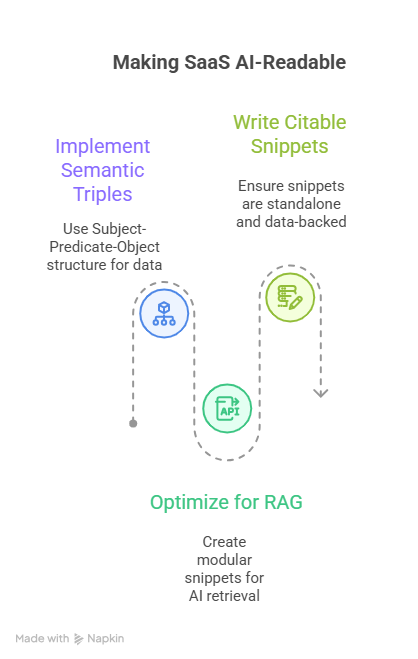
Implementing Semantic Triples for AI Extraction
The most effective way to “feed” an LLM is through Semantic Triples. This is a sentence structure that uses a Subject-Predicate-Object format.
- Weak (Traditional): “Our innovative platform helps teams work better together through a variety of unique tools.”
- Strong (LLM-Ready): “[SaaS Name] [Subject] automates sprint planning [Predicate] by syncing Jira tickets with Slack channels [Object].”
By using this “Answer-First” structure, you are essentially “pre-chewing” your data for the AI’s knowledge graph. It allows the model to categorize your product’s capabilities with 100% certainty.
Optimizing for RAG: The Art of the “Citable Snippet”
Most AI answers (like Perplexity or SearchGPT) use Retrieval-Augmented Generation (RAG). The AI “retrieves” a few snippets from the web and “generates” an answer based on them.
To win the citation, you must write in Modular Snippets. Every major section of your site should have a standalone paragraph (40–60 words) that provides a complete, data-backed answer.
Operational Tip: If an AI cannot copy-paste a single paragraph from your site and have it make sense as a standalone recommendation, you are effectively invisible to RAG-based search.
Also read: How to choose a SaaS content marketing agency in the AI era
The AI Landscape: Tailoring Strategy for Perplexity, Gemini, and ChatGPT
Think of these platforms as different types of researchers. If you know what they’re looking for, you can feed them exactly what they need to recommend you.
Perplexity: The “Real-Time Librarian”
Perplexity is the speed-runner of the group. It prizes freshness and third-party consensus.
- The Strategy: If you just launched a new feature or updated your pricing, Perplexity will likely find it first because it indexes multiple times a day.
- Where to win: It heavily cites Reddit, YouTube, and niche industry forums. If your brand isn’t being discussed in “human” spaces, Perplexity is less likely to trust your own website as the sole source of truth.
Gemini: The “Google Ecosystem Giant”
Gemini is the “insider.” It has a direct line to the world’s largest data repositories.
- The Strategy: Optimize your YouTube presence and your Google Business Profile. Gemini frequently pulls video transcripts to answer “how-to” questions and uses Google Maps data for any local or regional SaaS queries.
- Where to win: Use structured data (Schema 2.0) and ensure your YouTube descriptions are rich with the Semantic Triples we discussed in Section 3.
ChatGPT (SearchGPT): The “Authoritative Conversationalist”
ChatGPT leans on long-term reputation and deep technical documentation. It’s looking for the most “logical” and “authoritative” answer in its vast training set.
- The Strategy: Focus on E-E-A-T (Experience, Expertise, Authoritativeness, and Trustworthiness). It values whitepapers, detailed API docs, and mentions in legacy publications like Forbes or TechCrunch.
- Where to win: Consistency is key here. If your brand message is fragmented across the web, ChatGPT may struggle to form a cohesive recommendation.
Also read: Entity-First Content: How to Structure SaaS Content for ChatGPT and Gemini
Defensive LLM SEO: Managing Hallucinations and Brand Accuracy
Visibility is a double-edged sword. If an AI tells a prospect that your “Enterprise” software is a “free tool,” you’ve got a major sales friction problem. This is where most founders drop the ball: they focus on being found, but forget to manage how they are described.
Protecting the Brand Narrative in Conversational UI
AI models can “hallucinate” or rely on outdated data (like a 2-year-old Reddit thread about a bug you’ve already fixed).
- The Fix: You must proactively “flush” the AI’s memory by flooding high-authority datasets with current info. Update your Wikidata entry, your G2/Capterra profiles, and your official API documentation first. These are the “ground truth” sources AI models use to verify their answers.
Monitoring “Perception Drift”
Are you being categorized as a “Budget” tool when you’re “Premium”? You need to track Brand Sentiment within AI answers. If you notice a trend of inaccurate descriptions, it’s a signal that your website’s “Inference Advantage” (from Section 2) is weak. You need clearer, more definitive claims on your core pages.
Also read: SEO is No Longer Enough: How AI Search is Reshaping SaaS Discovery
Implementation Guide: A 90-Day LLM Optimization Sprint
Don’t let this be another “someday” project. Here is your operational checklist to dominate AI answers this quarter.
- Days 1-30: The AI Visibility Audit. Use a tool like LLM Pulse or Perplexity itself to ask 50 questions that your buyers ask. See who is currently getting the citation. If it’s not you, identify why (e.g., “Competitor X has a better comparison table”).
- Days 31-60: The Content Pivot. Don’t delete your blog, restructure it. Turn your top 10 most visited pages into “Modular Snippets.” Add Decision Blocks (tables, checklists, and 40-word summaries) to the top of every page.
- Days 61-90: The Consensus Build. Reach out to the third-party sites the AI is already citing (Reddit, G2, niche blogs). Ensure your brand is mentioned there with the correct, updated “Semantic Triples.”
Stop Ranking for Clicks and Start Dominating the Answer
Let’s be honest: The 90-day sprint outlined above is the future of SaaS growth, but it’s also a significant operational pivot. Most “SEO agencies” are still stuck in 2022, trying to sell you high-volume, low-intent keywords and AI-generated “fluff” that LLMs will eventually ignore or penalize.
This is where SaaS Leady comes in.
We don’t use AI agents to do our work; we use senior human strategists to help your brand dominate AI agents. We specialize in the intersection of traditional content-led SEO and Generative Engine Optimization (GEO).
We help B2B SaaS founders:
- Audit AI Visibility: Stop guessing and start seeing exactly how ChatGPT, Gemini, and Perplexity perceive your brand.
- Engineered Content & Links: We build content strategies and high-authority link profiles designed specifically to feed the knowledge graphs of major LLMs.
- Protect Your Brand: We clean up the “digital footprint” that causes AI hallucinations, ensuring your pricing, features, and positioning are reported with 100% accuracy.
If you’re ready to move from “Page 1” to being the “Definitive Answer,” let’s talk. We help you scale traffic that doesn’t just rank, but drives real business growth.
Conclusion: Winning the Answer, Not the Click
In 2026, the SaaS founders who win are the ones who realize that control is an illusion, but influence is measurable. You cannot force an AI to rank you, but you can make it nearly impossible for it not to cite you by providing the cleanest, most authoritative, and most structured data in your category.