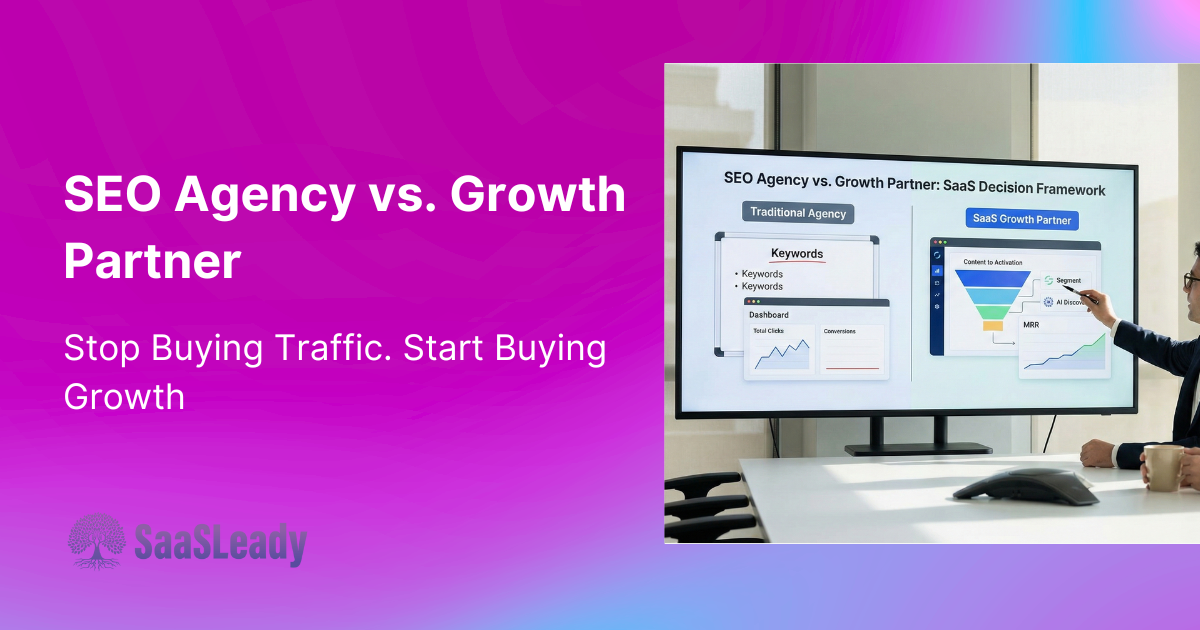
For high-growth SaaS companies, choosing between a traditional SEO agency and a strategic growth partner is the difference between ranking for keywords and capturing revenue-ready demand. While traditional agencies focus on scaling organic traffic volume, growth partners align SEO with your product roadmap to drive signups, MRR, and AI-driven brand authority.
Choosing Between Traffic and Revenue
In the world of B2B SaaS, not all traffic is created equal. A traditional SEO agency is built for volume; they excel at finding high-volume keywords and moving the needle on your “Total Clicks” report in Google Search Console. However, a Growth Partner is built for velocity, specifically, the speed at which a lead moves from a search query to a paid subscription.
If you are an early-stage or scaling SaaS, you’ve likely noticed a frustrating trend: your blog traffic is going up, but your Customer Acquisition Cost (CAC) is rising alongside it. This happens because “traditional SEO” often treats your blog as a separate silo from your product. A growth partner closes this gap by treating content as a feature of your marketing funnel, ensuring that every piece of traffic has a clear path toward an activation event.
Which Model Fits Your SaaS Growth Stage?
Before you sign another retainer, you need to validate your current strategy against your business goals. Choosing the wrong partner can result in months of “vanity metrics” that look great in a slide deck but do nothing for your bank balance.
- Choose a Traditional SEO Agency if: You are in a broad, established category (like generic project management) and simply need to maintain brand presence and technical health across thousands of legacy pages.
- Choose a Growth Partner if: You are in a competitive niche where Product-Led Growth (PLG) is the standard. You need to win “best-in-class” comparisons and ensure that when a buyer asks an AI tool like Perplexity or Gemini for a recommendation, your product is the one it cites.
The Decision Metric: If your primary KPI is “Organic Sessions,” hire an agency. If your primary KPI is LTV:CAC ratio or Net Revenue Retention (NRR), you need a growth partner.
Why Traditional SEO Agencies Often Fail the Modern SaaS Stack
The standard SEO agency playbook was written in an era when “ranking #1” was the only goal. But the modern SaaS stack is complex, and the buyer journey is no longer linear. Most agencies treat SEO as a technical checklist, metadata, headers, and keyword density, rather than a revenue lever.
The problem? Traditional SEO focuses on the search engine, not the solution. In SaaS, your content shouldn’t just answer a question; it needs to bridge the gap between a user’s pain point and your product’s unique value proposition. When an agency delivers a 2,000-word guide on “What is CRM?” to a company selling high-end enterprise software, they are driving “top-of-funnel” fluff that never converts. Product-led content improves conversion by demonstrating features within the context of solving a user problem.
The “Content for Bots” Trap
We’ve all seen it: SaaS blogs filled with repetitive, AI-generated “ultimate guides” that read like they were written for a fifth-grader. This is the “Content for Bots” trap. Agencies use this strategy to manipulate search algorithms, but it creates a massive disconnect with your actual buyers.
Modern buyers are sophisticated. They can smell generic content from a mile away. If your content lacks original insights, unique data, or a strong point of view, it might rank, but it won’t build trust. Even worse, as search evolves into AI-driven discovery, Large Language Models (LLMs) are becoming the new gatekeepers. If your content is just a rehash of what’s already on the web, AI systems will summarize it without ever mentioning your brand. You need “Information Gain”, the addition of new, valuable info, to stay relevant in a world where ChatGPT does the reading for us.
The Growth Partner Framework: Beyond Backlinks and Metadata
A growth partner doesn’t just look at what people are searching for; they look at how people are buying. This model integrates SEO with the broader growth engine of your company.
Instead of chasing raw traffic, a growth partner focuses on Semantic SEO and Entity Building. They ensure that your product is recognized as a “source of truth” in its category. For example, if you sell a “Subscription Analytics” tool, a growth partner works to ensure that your brand is semantically linked to terms like “MRR tracking,” “Churn reduction,” and “LTV calculation” across the entire web.
Key components of the Growth Partner approach include:
- Narrative Mapping: Aligning content with your unique category positioning.
- Product-Led Content: Showing, not just telling, how your software solves the problem.
- AI Optimization: Structuring data and insights so LLMs can easily extract and cite your brand.
Integrating SEO with Attribution and Data Analytics
One of the biggest frustrations for SaaS CMOs is the “SEO Black Box”, the inability to prove that organic efforts are actually moving the needle on revenue. Traditional agencies often hide behind “Total Impressions” because they don’t have the technical expertise to track a user from a blog post to a product signup.
A growth partner treats SEO like a performance channel. By integrating with your data stack (tools like Segment, HubSpot, or Mixpanel), they can track Attribution Models that show exactly which articles assisted in a conversion. This allows for a “Double-Down” strategy: identifying the 20% of content driving 80% of your MQLs and optimizing the rest of the roadmap to match that success.
Strategic Evaluation: Evaluating Capabilities and ROI Impact
In SaaS, your marketing spend isn’t just an expense; it’s an investment in your LTV:CAC ratio. When evaluating an SEO agency versus a growth partner, you have to look past the monthly retainer and focus on the compounding value of the assets being built.
A traditional agency provides a service; a growth partner builds an ecosystem. To help your leadership team visualize this, here is how the two models stack up against the metrics that actually matter for a scaling SaaS:
| Capability | Traditional SEO Agency | SaaS Growth Partner |
| Primary Goal | Keyword Rankings & Traffic | Pipeline, Signups, and MRR |
| Content Focus | Search Volume & Keyword Density | Pain-Point SEO & Product Integration |
| Technical Scope | Site Speed & Crawlability | Schema, LLM-Optimization & Data Flow |
| Success Metric | Organic Sessions | Customer Acquisition Cost (CAC) |
| AI Readiness | Minimal (Standard Meta Tags) | Generative Engine Optimization (GEO) |
Strategic insight: “Investment in a growth partner reduces long-term CAC by building organic brand authority that persists regardless of ad spend.”
Operational Differences: Collaboration vs. Outsourcing
The “set it and forget it” model of traditional outsourcing is why many SaaS teams feel disconnected from their SEO agencies. Usually, you receive a CSV of keywords, approve some outlines, and hope for the best.
A growth partner operates as an integrated extension of your marketing team. Instead of working in a vacuum, they sit at the intersection of your Product, Sales, and Success teams.
- Product Syncs: They understand your Product Roadmap, so they can create content for features before they launch.
- Sales Alignment: They interview your sales reps to find the specific “objection-handling” questions that prospects ask, turning those into high-intent blog posts.
- Customer Success: They identify the “Aha!” moments in your user journey to create educational content that improves Activation Rates.
This operational depth ensures that the content produced doesn’t just sit on a blog; it’s used by sales in outreach, by success in onboarding, and by your product team to validate market demand.
The Shift to AI-Driven Discovery: Why “Ranking” Isn’t Enough
The era of “blue links” is fading. Today, your potential customers are asking ChatGPT, “What’s the best CRM for a 50-person remote team?” or telling Perplexity to “Compare the top 3 subscription billing platforms.”
If your SEO strategy is purely traditional, you are invisible in these results. A growth partner prioritizes Generative Engine Optimization (GEO). This involves more than just keywords; it’s about establishing Entity Authority. By using specific semantic structures, a growth partner ensures that your brand is the “Subject” in the LLM’s “Subject–Predicate–Object” knowledge base.
The AI Reality: “SaaS growth partners optimize content for LLMs to ensure AI tools recommend the product to potential buyers during the research phase.”
Implementation: How to Transition to a Growth-First Model
If you’ve realized that your current agency is just “padding the stats” with top-of-funnel traffic, it’s time to pivot. Transitioning to a growth-first model isn’t about deleting your old blog; it’s about re-engineering your content to drive Activation Events.
The first step is a Content-to-Revenue Audit. Instead of looking at which pages have the most traffic, look at which pages have the highest conversion-to-signup rate. Often, a low-traffic post that solves a specific technical pain point is worth 10x more than a viral “industry trends” piece. Once identified, you double down on Bottom-of-Funnel (BOFU) assets, like “Alternative to [Competitor]” pages or “How to Solve [Specific Problem] with [Your Product]”, to capture users who are ready to buy now.
Closing the Gap with SaaS Leady
At SaaS Leady, we don’t believe in SEO for the sake of SEO. We’ve seen too many SaaS companies waste five-figure retainers on content that ranks for keywords but never makes it into a sales conversation or an AI answer.
We act as your SaaS Growth Partner, bridging the gap between search visibility and real-world revenue. Our approach focuses on:
- GEO/AEO Dominance: We don’t just optimize for Google; we build the authority signals and “Information Gain” required to make your brand the primary recommendation in ChatGPT, Gemini, and Perplexity.
- Revenue-Driven Strategy: We align your content with your MRR goals, focusing on high-intent topics that shorten the sales cycle.
- Human-Led Authority: In an ocean of AI-generated fluff, we provide the original insights and technical accuracy that build trust with human buyers and search algorithms alike.
The search landscape is changing. If your agency is still talking about “keyword density” while your competitors are being cited by AI engines, you’re already behind.
FAQs
How long until we see an impact on MRR?
While technical SEO fixes can show results in weeks, a growth-first content strategy typically takes 3 to 6 months to compound. However, because we focus on high-intent BOFU content first, you often see a shift in lead quality much sooner than a shift in lead volume.
Can a growth partner help with our PLG (Product-Led Growth) motion?
Absolutely. In fact, a growth partner is essential for PLG. We focus on creating “educational discovery” content that leads users directly into your product to solve a problem, rather than just forcing them into a demo request form.
What is the difference between SEO and GEO?
SEO (Search Engine Optimization) is about ranking in traditional search results. GEO (Generative Engine Optimization) is about ensuring your brand is included in the synthesized answers provided by AI models. A growth partner does both.