Optimizing for LLM ingestion increases SaaS brand mentions in AI responses by up to 40%, directly influencing the “hidden funnel” where 2026 buyers now research software before ever visiting a landing page.
The ROI of AI-Readiness: How Ingestion Impacts Your CAC and Pipeline
Being the “preferred recommendation” of an LLM is the 2026 version of a high-trust referral. When an AI tells a user, “You should use [Your SaaS] because it has the fastest API response time in the category,” that lead arrives at your site already 80% through the consideration phase.
AI-validated leads convert at a higher rate because the ‘selection’ happened before the first click. This significantly reduces your Customer Acquisition Cost (CAC). Instead of paying for expensive PPC bids on competitive terms, you are earning “organic” placement in the most trusted research tool of the modern buyer. This shifts your marketing spend from defensive bidding to offensive authority building.
Tracking Attribution in the “Zero-Click” Era
We’ve officially entered the era of “Zero-Click” discovery. A buyer might see your name in a Gemini response, mention it to their CTO in Slack, and then three weeks later, the CTO types your URL directly into their browser.
Product analytics identifies activation trends, but brand search volume tracks LLM-driven discovery. Since you can’t see the “referral link” from a private ChatGPT session in your Google Analytics, you have to look for the “echo.” An uptick in direct traffic and branded searches often correlates with a high “Share of Voice” in AI responses. To get a clearer picture, add a “How did you hear about us?” field to your signup flow. If “AI Search” starts appearing, your checklist is working.
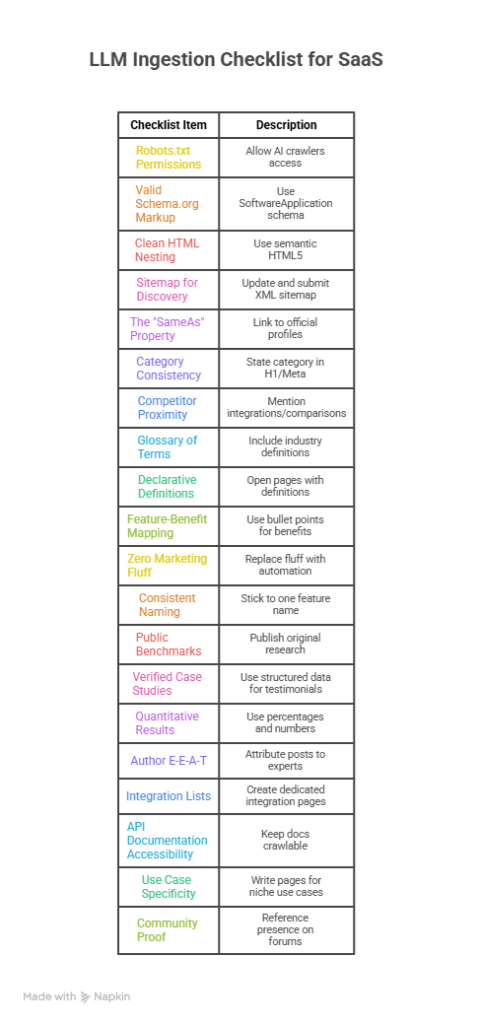
The 20-Point LLM Ingestion Checklist for SaaS
To get cited by an LLM, your website needs to be more than just “readable”; it needs to be “digestible.” Large Language Models don’t browse; they ingest. This process involves scraping, parsing, and then creating a mathematical representation (an embedding) of your brand. If your data is messy, your brand’s representation will be too.
Section 1: Technical Scrape-ability & Architecture
Before an AI can recommend you, its crawler has to be able to see you. Unlike Google’s crawler, AI bots like GPTBot, CCBot, and OAI-SearchBot are looking for structured facts rather than just keyword clusters.
- 1. Robots.txt Permissions: Explicitly allow AI-specific crawlers to access your high-value pages.
- 2. Valid Schema.org Markup: Use SoftwareApplication or SaaS schema to define your product category, price, and features.
- 3. Clean HTML Nesting: Avoid “div soup.” Use semantic HTML5 (<article>, <section>, <nav>) so the parser knows what the header is and what is the core content.
- 4. Sitemap for Discovery: Ensure your XML sitemap is updated and submitted via Search Console to prioritize your most important feature pages.
Section 2: Semantic Entity Anchoring
LLMs understand the world through “entities”, identifiable concepts like “Salesforce” or “Customer Relationship Management.” You need to anchor your SaaS product to the right entities so the AI knows exactly where you fit in the market.
- 5. The “SameAs” Property: Use JSON-LD to link your website to your official LinkedIn, G2, and Crunchbase profiles.
- 6. Category Consistency: Clearly state your category (e.g., “Marketing Automation Platform”) in your H1 and Meta tags.
- 7. Competitor Proximity: Mention who you integrate with or compare to (e.g., “An alternative to HubSpot for small teams”) to help the AI map your position.
- 8. Glossary of Terms: Include a library of industry definitions to establish your site as a topical authority in your niche.
Section 3: Value Proposition Clarity (Subject-Predicate-Object)
AI models extract facts using a “triples” format: Subject -> Predicate -> Object. If your writing is too flowery, the AI loses the thread.
- 9. Declarative Definitions: Open pages with “Product X is a [Category] that does [Primary Function].”
- 10. Feature-Benefit Mapping: Use clear bullet points like “Our API reduces latency by 30%.”
- 11. Zero Marketing Fluff: Replace “Unleash your potential” with “Automate lead scoring.”
- 12. Consistent Naming: Don’t call your feature “The Magic Wand” on one page and “Automated Reporting” on another. Stick to one name.
Also read: Entity-First Content: How to Structure SaaS Content for ChatGPT and Gemini
Section 4: Data-Backed Authority Signals
LLMs look for “grounding truth”, real-world data that proves your claims aren’t just marketing hype.
- 13. Public Benchmarks: Publish original research or industry benchmarks that AI models can cite as a source.
- 14. Verified Case Studies: Use structured data for testimonials to prove your product solves real problems for real companies.
- 15. Quantitative Results: Product analytics improves activation by identifying specific drop-off points, using specific percentages and numbers (e.g., “15% increase in MRR”).
- 16. Author E-E-A-T: Ensure blog posts are attributed to real experts with linked biographies to prove Expertise and Trustworthiness.
Section 5: Integration & Ecosystem Context
In the SaaS world, no tool is an island. AI models often recommend software based on how well it fits into a user’s existing “stack.”
- 17. Integration Lists: Create dedicated pages for every integration (e.g., “SaaS X + Slack Integration”).
- 18. API Documentation Accessibility: Keep your API docs crawlable (not behind a login) so the AI knows exactly what your tool can automate.
- 19. Use Case Specificity: Write pages for “SaaS for Fintech” or “SaaS for Healthcare” to capture niche-specific AI queries.
- 20. Community Proof: Reference your presence on GitHub, Stack Overflow, or specialized forums where developers discuss your tool.
Implementing the Checklist: A Phased Adoption Strategy
You don’t need to rewrite your entire website overnight to be AI-ready. In fact, trying to do so often leads to “over-optimization” that feels robotic to your human visitors. The goal is a phased approach that prioritizes the pages where buyers are making their final decisions.
Start by auditing your bottom-of-funnel pages, such as pricing, integrations, and “Alternative To” comparisons. These are the pages LLMs lean on most heavily when a user asks for a recommendation. Once those are structurally sound, using the Subject-Predicate-Object clarity we discussed, you can move upstream to your educational blog content and top-of-funnel guides.
Also Read: How AI answers replace traditional SaaS comparison pages
Auditing Your “AI Share of Voice”
How do you know if this is actually working? Since there isn’t a “Google Analytics for ChatGPT” (yet), you have to get creative with your testing. Run a weekly “AI Audit” by prompting the major models, Gemini, GPT-4, and Perplexity, with queries your customers might use.
Ask questions like: “What are the top three tools for [Your Category] that integrate with [Key Integration]?” or “Compare [Your Product] vs [Competitor] for a mid-market SaaS team.” If the AI is missing key features or hallucinating details, you know exactly which section of your checklist needs attention.
Stop Guessing, Start Appearing: Is Your SaaS Actually Visible to AI?
Running through a checklist is a great first step, but the “Answer Engine” landscape moves fast. While you’re busy shipping features and hitting MRR targets, AI models are constantly re-indexing the web and deciding which SaaS brands deserve the “Expert Recommendation” tag and which ones get left in the hallucination pile.
At SaaS Leady, we don’t just write content; we build authority signals. We specialize in bridging the gap between traditional SEO and the new world of Generative Engine Optimization (GEO). We help B2B SaaS companies transform their websites into high-density “knowledge hubs” that LLMs like ChatGPT, Gemini, and Perplexity can’t help but cite.
How we help you dominate the “Hidden Funnel”:
- LLM Visibility Audits: We deep-dive into your site’s architecture to find the “dead zones” where AI crawlers are getting lost.
- Semantic Entity Mapping: We ensure your product is mathematically linked to the right categories and competitors in the AI’s latent space.
- Human-First, AI-Optimized Content: We produce high-authority articles and case studies that resonate with human buyers while remaining perfectly structured for machine ingestion.
- The “Agentic” Roadmap: We prepare your documentation for the 2026 shift toward AI agents performing software evaluations on behalf of your customers.
Don’t let your competitors own the AI conversation. If you want to move beyond “ranking” and start being the answer, let’s talk.