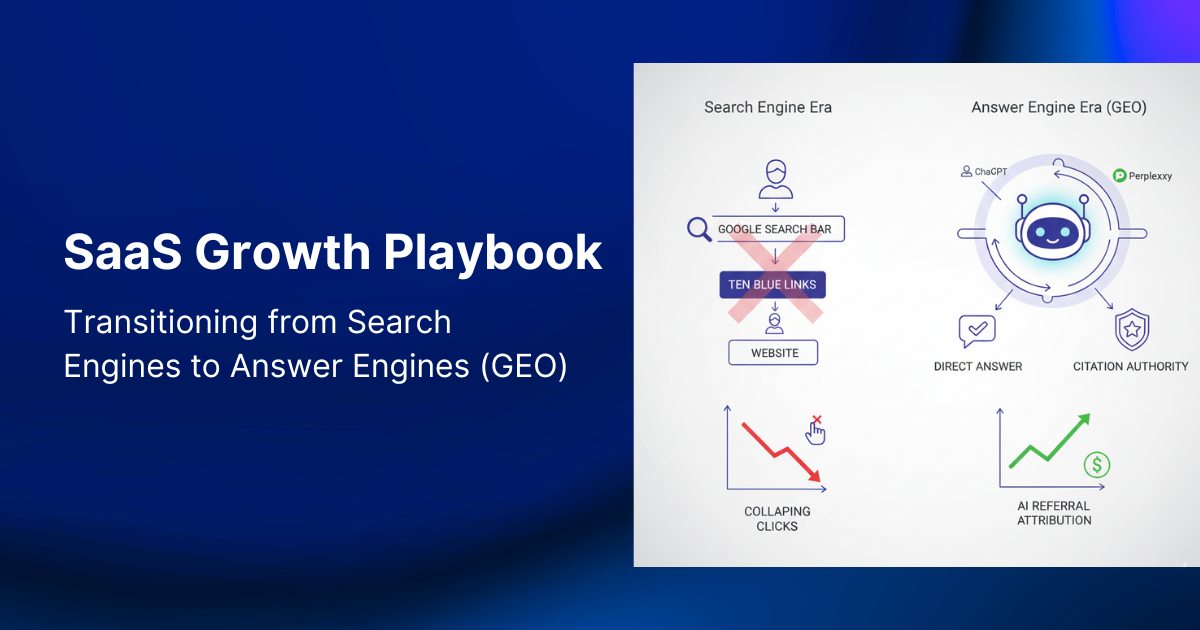
For over a decade, the SaaS growth playbook was predictable. You identified a high-volume keyword, produced a 2,000-word article, built a handful of backlinks, and waited for the “Blue Link” traffic to arrive.
That era is officially over.
Recent data suggests that search engine volume is predicted to drop significantly as users move toward AI-driven interfaces that provide immediate answers without the need for a click. If your SaaS isn’t part of that synthesized answer, you aren’t just ranking lower—you are invisible.
In 2026, we are witnessing the “Quiet Collapse” of the traditional click. Google’s Search Generative Experience (SGE), Perplexity, and ChatGPT have fundamentally changed user behavior. Users no longer want a list of links to sift through; they want a synthesized answer.
When a CTO asks, “Which CRM has the best API for a fintech startup?”, they aren’t looking for a blog post titled “Top 10 CRMs in 2026.” They are looking for the LLM to analyze the market and provide a singular, trusted recommendation.
If your SaaS isn’t part of that synthesized answer, you aren’t just ranking lower—you are invisible.
Key Takeaways
- Citations are the new Rankings: It’s no longer about being #1 on a page; it’s about being the source the AI uses to answer the question.
- Unique Data Wins: If your content just repeats what’s already on the internet, AI will summarize it and keep the click. You must provide proprietary insights to earn a visit.
- Trust is your Moat: Consistency across your website, technical schema, and review sites (like G2) is what stops AI from “hallucinating” your brand.
Beyond SEO: Enter Generative Engine Optimization (GEO)
To survive this shift, SaaS brands must move beyond Search Engine Optimization (SEO) and embrace Generative Engine Optimization (GEO).
While SEO focuses on ranking in an index, GEO focuses on being cited by a model. At SaaS Leady, we define this shift as GEO—a term supported by academic research into Generative Engine Optimization that describes how brands must optimize to be cited and recommended by Large Language Models (LLMs).
In the GEO landscape, being the #1 result on a search page is no longer the “gold medal.” The new gold medal is the primary citation used by an AI to answer a buyer’s question.
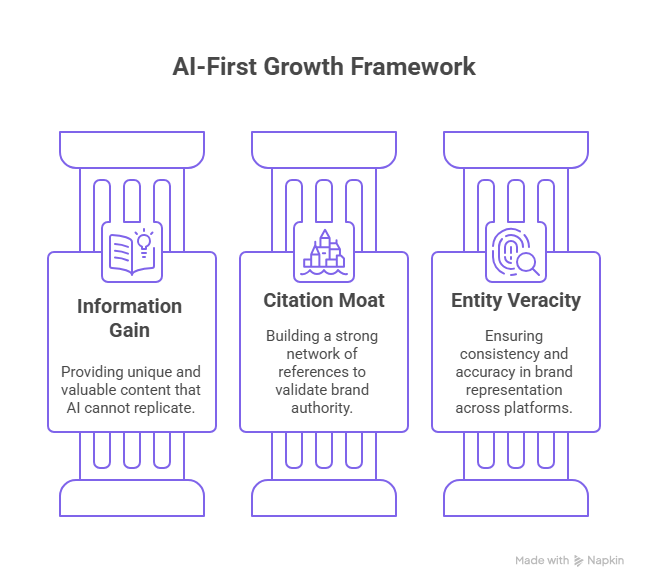
The 3-Pillar Framework for AI-First Growth
At SaaS Leady, we have identified three core pillars that determine whether a SaaS brand is “AI-visible” or “AI-invisible.”
1. The “Information Gain” Threshold
LLMs have already “read” the entire internet. If your content simply repeats what is already in the training data (e.g., “What is a CRM?”), the AI will summarize your content and never send the user to your website. To win a click, you must provide Information Gain. This includes:
- Proprietary Data: Internal benchmarks or user surveys.
- Unique Frameworks: New, named methodologies for solving old problems.
- First-Hand Experience: Deep-dive case studies that AI cannot hallucinate or replicate.
2. The Citation Moat (Modern Link Building)
Backlinks are no longer just “points” for a ranking algorithm. In the GEO world, they are referential proof. When high-authority SaaS peers, industry news sites, or niche experts mention your tool, it validates your brand “entity” in the eyes of the LLM. We focus on building a “Citation Moat”—getting your brand mentioned in the exact contexts where your customers are asking questions.
3. Entity Veracity & Accuracy
AI models prefer to cite brands that have a consistent digital footprint. We audit your brand’s digital presence against standardized Schema markup to ensure your product features and pricing are recognized as verified facts, reducing the risk of AI hallucinations.
Measuring Success: The New KPIs
How do you know if your GEO strategy is working? Traditional metrics like “Organic Sessions” are only one piece of the puzzle. In 2026, we track:
- Share of Model (SoM): How often is your brand recommended by ChatGPT vs. your competitors?
- Citation Velocity: How frequently are AI crawlers (like GPTBot) accessing your deep-funnel content to update their knowledge?
AI Referral Attribution: Using advanced event-tracking to identify signups that originated from “Answer Engine” queries.
Conclusion: The Competitive Advantage of the Early Mover
The shift from Search Engines to Answer Engines is the biggest disruption to SaaS marketing in a decade. You can either continue fighting for a shrinking number of clicks in the “Ten Blue Links,” or you can optimize for the engines that are actually making decisions for your customers.
FAQs about GEO
GEO is the strategic process of optimizing a brand’s digital presence to be cited and recommended as a primary source by AI-driven answer engines like ChatGPT, Gemini, and Perplexity.
While SEO focuses on ranking in a list of links (blue links), GEO focuses on becoming the primary source used by an AI to synthesize a direct, conversational answer for a user.
No. In fact, backlinks are more important in GEO, but the quality and context matter more. AI engines use high-authority mentions as “verified citations” to ensure the information they provide is accurate and trustworthy.
Because AI models update their “knowledge” frequently through web crawling (like GPTBot), technical GEO changes can be reflected in days. However, building “Entity Authority” and a citation moat typically takes 3 to 6 months of consistent effort.