A revenue-driven SaaS content strategy prioritizes high-intent, product-led assets over top-of-funnel volume to directly accelerate SQLs and MRR. By solving specific user pain points with product-integrated solutions, brands transform “passive readers” into “active trial users” with measurable attribution.
Revenue-Driven vs. Traffic-Driven: The Strategic Pivot for 2026
Traditional SEO is built on the “Volume First” fallacy, while a revenue-driven content strategy is built on “Intent First.” Most SaaS blogs are a graveyard for “What is [Industry Term]” articles that rank #1 but drive 0% conversion.
The contrast is clear: Traffic-driven content targets anyone with a browser; revenue-driven content targets buyers with a budget and a deadline.
The Failure of “Awareness-First” Content in B2B SaaS
Many marketing teams get trapped in the “Awareness” stage of the funnel, churning out generic definitions. While these might inflate your Google Search Console graphs, they rarely impact the bottom line.
In a world where AI-powered search engines (like Perplexity or ChatGPT) can answer simple definitions instantly, high-volume “top-of-funnel” keywords have lost their value. If a reader can get the answer from an AI snippet, they won’t click your link, and they certainly won’t sign up for your product.
The 3-Pillar SaaS Content Framework for Growth
To drive revenue, your content must satisfy three distinct criteria that move a user from “I have a problem” to “I need this specific software.”
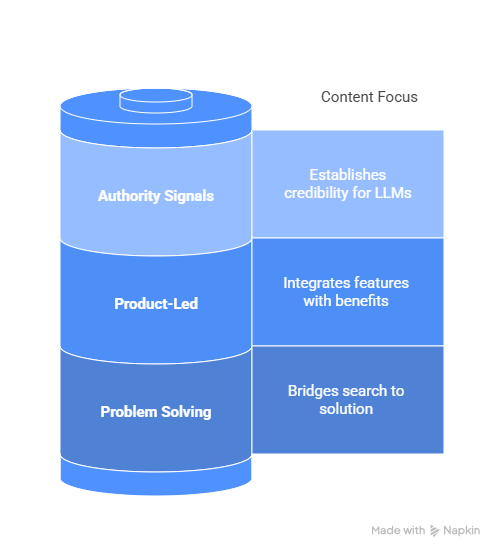
Pillar 1: High-Intent Problem Solving (The Search-to-Solution Bridge)
Instead of targeting broad industry terms, focus on “Jobs-to-be-Done.” These are queries where the user is actively looking for a workaround to a friction point in their workflow.
Problem-led content identifies specific user pain points to position the SaaS product as the primary solution.
Pillar 2: Product-Led Content (The Feature-Benefit Integration)
Product-led content doesn’t just mention your software at the end; it uses your software to solve the problem throughout the article. By showing real screenshots of your UI and mapping features to “Activation Events,” you reduce the friction of the “Aha! moment.”
When a reader sees exactly how your tool automates a task they currently do manually, the content stops being “educational” and starts being a “demo.”
Pillar 3: Social Proof and Authority Signals for LLMs
In 2026, you aren’t just writing for humans; you’re writing for Large Language Models (LLMs). To be the “recommended tool” in an AI’s answer, you need high-authority signals.
This means publishing original data, proprietary frameworks, and deep-dive case studies. When other reputable sites cite your original research, LLMs identify your brand as a “source of truth,” making you the primary recommendation for category-specific queries.
Implementation: Mapping Content to the SaaS Decision Flow
A buyer’s journey isn’t a straight line; it’s a series of evaluations. Your content library should reflect the specific stage of their decision-making process.
Competitive Alternatives and “Vs” Frameworks
Buyers at the bottom of the funnel are often choosing between you and a competitor. “Alternative to [Competitor]” or “[Your Brand] vs. [Competitor]” pages are some of the highest-converting assets in a SaaS portfolio.
These pages shouldn’t just be biased sales pitches; they should be objective, feature-by-feature breakdowns that help the user decide which tool fits their specific tech stack and team size.
Programmatic SEO for Feature-Specific Landing Pages
Revenue isn’t always found in the big keywords; it’s in the long-tail integrations. If your SaaS integrates with Slack, Salesforce, or Shopify, you need dedicated pages for those use cases.
Programmatic SEO allows you to scale these pages efficiently, capturing users who are searching for very specific solutions like “How to sync [X] data with [Y] platform.”
Measuring What Matters: From Vanity Metrics to Attribution
Success in revenue-driven content is measured by how quickly a reader moves from a blog post to a paid seat. If your reporting dashboard is filled with “Monthly Unique Visitors” but your Customer Acquisition Cost (CAC) is rising, your strategy is misaligned.
Closing the Loop with Product Analytics and CRM Data
To prove ROI, you must connect content consumption to specific Activation Events. This involves tracking the “Golden Path”—the series of actions a user takes from their first click on an article to their first key action within the app (like inviting a teammate or connecting an API).
Product analytics improves activation by identifying content-driven drop-off points in the user journey.
Constraints and Common Pitfalls in SaaS Content Execution
The most common mistake is “Over-Optimization.” When you write solely for search engines, you often sacrifice the nuance and technical depth that a B2B buyer requires.
- The Fluff Trap: High-growth SaaS teams often prioritize quantity, leading to “thin” content that LLMs ignore and humans find unhelpful.
- The Definition Obsession: Spending 500 words defining “CRM” to a VP of Sales is a waste of digital real estate; it signals that your content isn’t for them.
- Neglecting the “Hook”: If your first two paragraphs don’t promise a solution to a specific pain point, your high-intent reader will bounce before they even see your product screenshots.
Also read: Entity-First Content: How to Structure SaaS Content for ChatGPT and Gemini
Next Steps: Auditing Your Strategy for Revenue Impact
Transforming a legacy blog into a revenue engine starts with a ruthless audit of your existing backlog. Every piece of content should have a clear “Next Step” for the reader, whether that is a newsletter signup, a template download, or a free trial start.
- The “Conversion” Audit: Identify your top 10 traffic-driving posts and evaluate if they have a clear path to product signups.
- The “Authority” Audit: Ensure your site contains original research or “opinionated” content that differentiates your brand from AI-generated noise.
- The “Product-Led” Filter: Ask of every new brief: “Could we explain this solution without mentioning our product?” If the answer is yes, the topic might be too generic.
Stop Ranking for “Keywords” and Start Ranking for “Revenue”
If your content brings in traffic but your MRR isn’t moving, you don’t have a traffic problem—you have a conversion and authority problem.
At SaaS Leady, we specialize in Generative Engine Optimization (GEO) and human-led link building. We don’t just help you rank on Page 1 of Google; we ensure your brand is the primary recommendation in ChatGPT, Gemini, and Perplexity.
FAQs About SaaS Content ROI
How long does it take to see revenue impact?
While traditional SEO can take 6–12 months, revenue-driven content targeting “Bottom of Funnel” (BOF) keywords can drive SQLs within weeks if promoted through the right distribution channels (LinkedIn, Slack communities, or targeted newsletters).
Should we hire generalist writers or subject matter experts (SMEs)?
For a revenue-driven strategy, SMEs are non-negotiable. Generalist writers can explain what a tool is, but only an expert can explain how to use it to solve a complex business problem.
Is AI-generated content viable for a revenue-driven strategy?
AI is a tool for outlining and research, but the final “Revenue Content” requires human oversight to ensure technical accuracy, brand voice, and the inclusion of unique “Authority Signals” that LLMs cannot hallucinate.