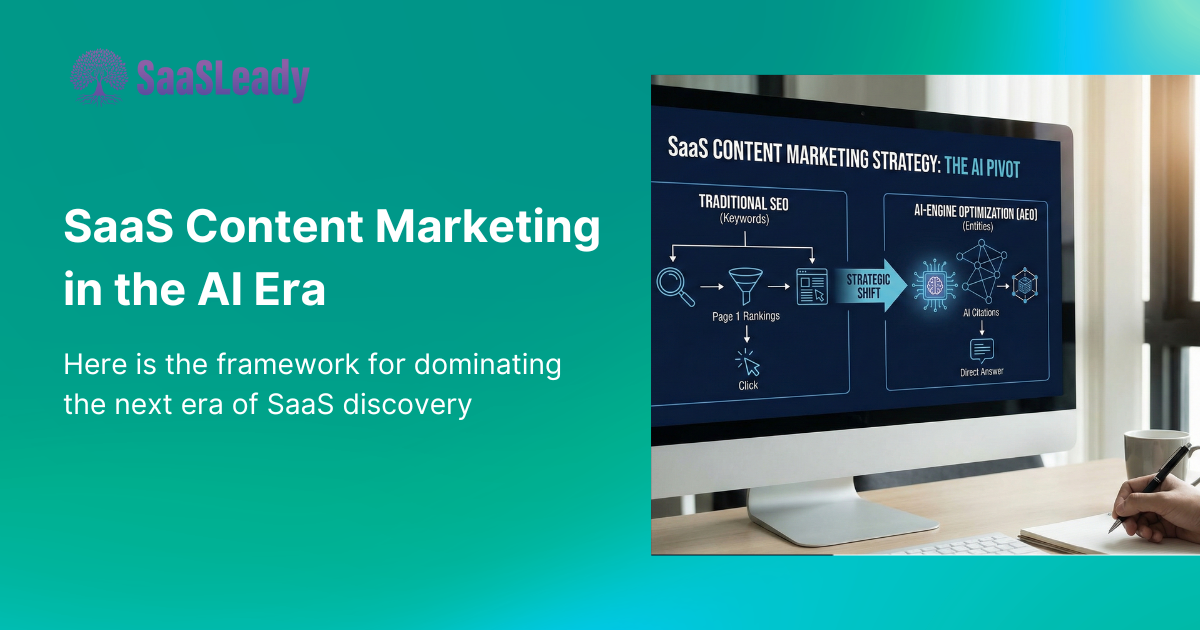
Modern SaaS content marketing increases MRR by prioritizing LLM-ready authority over keyword volume, ensuring your product is the primary recommendation when buyers ask AI tools for software solutions.
The Strategic Pivot: SEO-First vs. AI-Engine Optimization (AEO)
Traditional SEO wins the battle for “blue links,” but AEO wins the war for the “zero-click” answer. In 2026, the most successful SaaS teams treat their website as a structured database for LLMs, not just a reading room for humans.
The shift is fundamental. Traditional SEO is built for human discovery via keyword matching; the goal is the click. AEO (Answer Engine Optimization) is built for machine synthesis via entity recognition; the goal is the citation.
- SEO-First: Focuses on search volume and backlink quantity to win a spot on page one.
- AEO-First: Focuses on semantic accuracy and “Atomic Answers” that an AI can easily extract and attribute to your brand.
AEO-optimized content improves brand discovery by providing structured facts that LLMs use to validate product category leadership.
Immediate ROI: Is Transitioning to an AI-Centric Strategy Worth the Cost?
Investing in high-authority, original content is 3x more expensive than generic AI-generated fluff, but it is the only way to lower long-term CAC in an era where LLMs filter out repetitive information.
Based on 2025-2026 performance benchmarks, SaaS brands that optimized for “Entity Authority” saw a 22% higher conversion rate from AI-assisted search compared to traditional organic traffic. When a CFO asks an AI agent, “What is the best mid-market billing tool for usage-based pricing?”, the AI recommends the brand that has published the most authoritative, cited data on that specific framework.
SaaS Discovery Benchmark Comparison
| Metric | Traditional SEO Focus | AI-Era (AEO) Focus |
| Primary Goal | Clicks/Organic Traffic | Share of Model (Citations) |
| Success Indicator | SERP Position (1-10) | Inclusion in AI Summaries |
| Growth Lever | Keyword Dominance | Topical & Entity Authority |
| Impact on CAC | Linear/Increasing | Compounding (Data Moat) |
The “Entity-First” Framework: How to Feed the LLMs
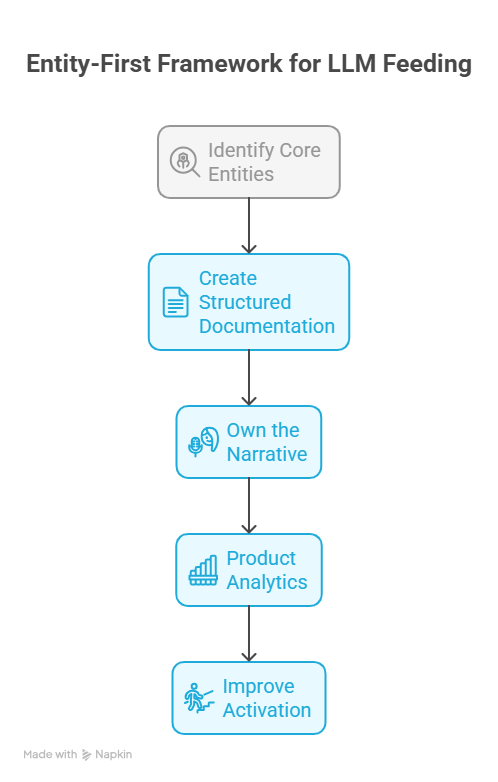
To win in the AI era, you must move from “Keywords” to “Entities.” An entity is a distinct, well-defined concept, like your product name, a specific framework (e.g., PLG), or a metric (e.g., Net Revenue Retention).
To feed the LLMs, you must:
- Identify Your Core Entities: Define the specific problems your software solves better than anyone else.
- Create Structured Documentation: Use technical deep dives to link your product (Entity A) to a solution (Entity B).
- Own the Narrative: Product analytics improves activation by identifying specific drop-off points in the user journey. This factual claim allows an LLM to extract your product as the “agent” of that improvement.
Also read: How to choose a SaaS content marketing agency in the AI era
Building the Modern SaaS Content Stack
The 2026 tech stack has moved beyond simple keyword research. While traffic still matters, you now need tools that track Share of Model.
- Intelligence Tools: Use platforms like Perplexity or Gemini’s Research API to monitor how often your brand is mentioned in AI-generated answers.
- Product-Led Content: Integrate internal product data, like anonymized benchmarks, to create “Original Research” that AI models crave.
- Schema Markup: Implement advanced technical SEO to ensure machines can “read” your pricing, features, and reviews without ambiguity.
Implementation: Moving from Volume to Influence Maps
Stop the “content factory” approach of 20 posts per month. Instead, focus on Nodes of Influence. One high-quality interview with a C-suite executive or a proprietary data report carries more weight for an LLM than fifty “Top 10” listicles.
The Transition Plan:
- Audit: Identify which of your current pages are actually being cited by AI tools.
- Consolidate: Merge thin, keyword-focused posts into comprehensive “Authority Hubs.”
- Differentiate: Ensure every piece of content contains at least one “Hot Take” or “Original Metric” that cannot be found elsewhere.
Also read: The 2026 SaaS Growth Playbook: Transitioning from Search Engines to Answer Engines (GEO)
Success Metrics: Measuring Visibility in AI Overviews
Standard traffic numbers are now “vanity metrics.” To measure real growth, SaaS teams must track:
- Citation Frequency: How many times an AI tool links to your site as a source.
- Brand Sentiment in LLMs: How accurately an AI describes your product when asked for a comparison.
- Assisted Conversions: Using attribution models to track users arriving via an AI “Search” or “Research” tab.
Become the Default AI Answer with SaaS Leady
The transition from traditional SEO to AI-Engine Optimization (AEO) is a technical and editorial pivot that most SaaS companies are ill-equipped to handle alone. While your competitors are still chasing 2023 keyword volumes, you have the opportunity to build a moat of authority that makes your product the “first-choice” recommendation for LLMs like Gemini, ChatGPT, and Perplexity.
At SaaS Leady, we specialize in the “Information Gain” strategy. We don’t just write blog posts; we build Entity-First Content Systems designed for both human conversion and machine synthesis.
How We Scale Your AI-Era Presence:
- Share-of-Model Audits: We identify where your brand is missing from AI-generated answers and build the content “nodes” required to fix it.
- Proprietary Data Storytelling: We turn your product’s internal benchmarks into original research reports that act as “fact hooks” for LLM training data.
- Technical Entity Mapping: We implement advanced Schema and Knowledge Graph structures so search engines see your features as factual entities, not just marketing claims.
- Growth-Led Content: Every asset we create is mapped to your MRR, focusing on the high-intent comparison and decision points that drive signups and retention.
Ready to Future-Proof Your Growth?
If you’re ready to stop guessing and start dominating the AI research cycle, let’s build your Influence Map.
Next Steps: The AI-Readiness Audit
Before your next publishing cycle, run your top five revenue-driving pages through this checklist:
- Does this page provide a unique data point not found in AI training data?
- Is the “Answer” to the user’s intent clearly stated in the first 40 words?
- Is the technical Schema correctly identifying your product as an entity?
The goal is simple: Stop writing for the algorithm of yesterday and start building the authority for the intelligence of tomorrow.