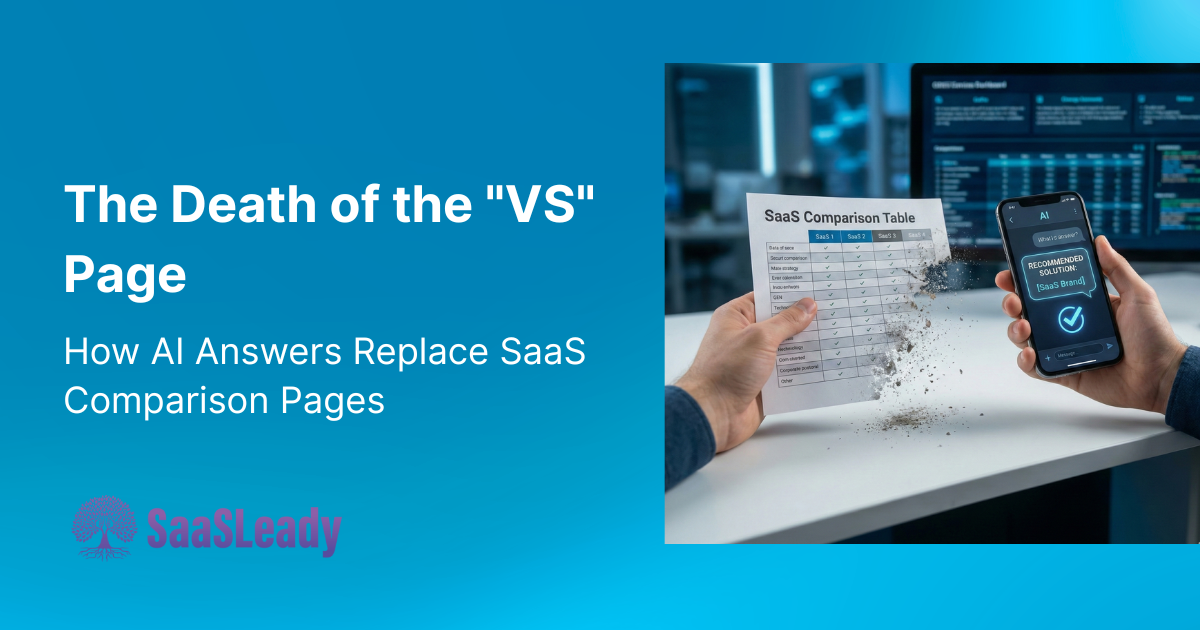
AI answer engines satisfy over 60% of software comparison queries directly, making static “Alternative” landing pages obsolete unless they are structured as machine-readable data sources that prioritize authoritative citations over keyword density.
Stop Building “Alternative” Pages, Start Building “Source” Authority
If you are still obsessing over ranking #1 for “Competitor A vs Competitor B,” you’re fighting for a click that might never happen. In 2026, the SaaS buyer’s journey has compressed. Instead of a prospect opening six tabs to compare features, they ask Perplexity or ChatGPT: “Which CRM has the best automated lead scoring for a PLG motion?” The AI doesn’t just send them to a list; it builds a dynamic comparison table on the spot. To win, your strategy must pivot from human-only engagement to source-first authority.
Traditional pages are built for keyword density and high-volume “Best [Category]” traffic; AI-optimized content is built for semantic extraction and entity-based recognition.
- The Decision: You must choose between defending a declining organic click-through rate (CTR) or becoming the “Trusted Source” that AI models cite when they generate recommendations.
- The ROI: SaaS brands optimized for AI visibility see 6x stronger conversion rates because the AI’s recommendation carries an implicit third-party endorsement.
How LLMs Synthesize SaaS Comparisons (Without Your Permission)
Modern Large Language Models (LLMs) like GPT-5 and Gemini 2.0 no longer rely solely on your marketing copy. They act as autonomous researchers, crawling your documentation, public API schemas, and third-party review platforms like G2 to verify your claims.
The Mechanics of “Agentic” Evaluation
When an AI agent evaluates your software, it isn’t looking for “game-changing solutions” or “synergistic workflows.” It is looking for entities and attributes. It scans for specific activation metrics, attribution models, and funnel stages to see if your tool actually fits the user’s prompt.
- Comparison Hook: While Legacy SEO tries to trick bots with hidden text and backlink clusters, AIO (AI Optimization) succeeds by providing a “Single Source of Truth” that AI models can’t ignore.
- Operational Accuracy: AI crawlers prioritize structured data (Schema.org) to identify MRR tracking capabilities or CAC-to-LTV ratios within your product descriptions.
Product documentation provides technical specifications that allow AI agents to validate feature parity across competitors.
Is Your Product Invisible to AI?
If your brand doesn’t appear when you prompt ChatGPT or Perplexity for a recommendation, you aren’t just losing a click; you’re losing the entire market. At SaaS Leady, we specialize in AIO (AI Optimization). We don’t just build content that ranks; we build “Entity Authority” that ensures your software is the cited source in every AI-generated comparison.
Transitioning from Keyword Dominance to Authority Signaling
In the old playbook, SaaS SEO was about capturing broad, high-volume keywords like “Best Project Management Software.” Today, those terms are heavily mediated by AI summaries that aggregate the top 10 results into a single answer. To stay relevant, you have to move beyond keywords and start focusing on Authority Signaling. This means moving your focus from search volume to entity confidence.
- The Shift: Traditional SEO wins clicks; Authority Signaling wins the “recommendation” in the AI’s generated response.
- The Logic: If an AI model cannot verify your claims through multiple independent sources, it won’t risk “hallucinating” your product into a recommendation.
Also read: Why Your SaaS Content Drives Traffic but Zero Signups
Leveraging Third-Party Validation for AI Trust
AI models are trained to be skeptical of first-party marketing fluff. They cross-reference your “Alternative” page claims against “ground truth” datasets like G2, Capterra, and GitHub discussions. If your landing page says you have a “Seamless Salesforce Integration” but your documentation or user reviews mention frequent API timeouts, the AI will prioritize the negative signal to protect its own accuracy.
- Strategy Hook: Your G2 profile is now more influential for your SEO than your own blog.
- The Framework: Treat review platforms as “data feeding grounds” for LLMs. A high volume of specific, technical reviews acts as a verifiable footprint that tells the AI your product is a legitimate contender in its category.
- SaaS Entity Anchor: Use G2’s “Grid” data and C2 reviews to ensure your product’s feature set is mapped correctly in the AI’s latent space.
Also read: What a Revenue-Driven SaaS Content Strategy Actually Looks Like
Implementation: 4 Steps to Future-Proof Your SaaS Content
Transitioning to an AI-first content strategy isn’t about deleting your blog; it’s about restructuring how you present information so it’s “scrappable” and “verifiable” for machine agents.
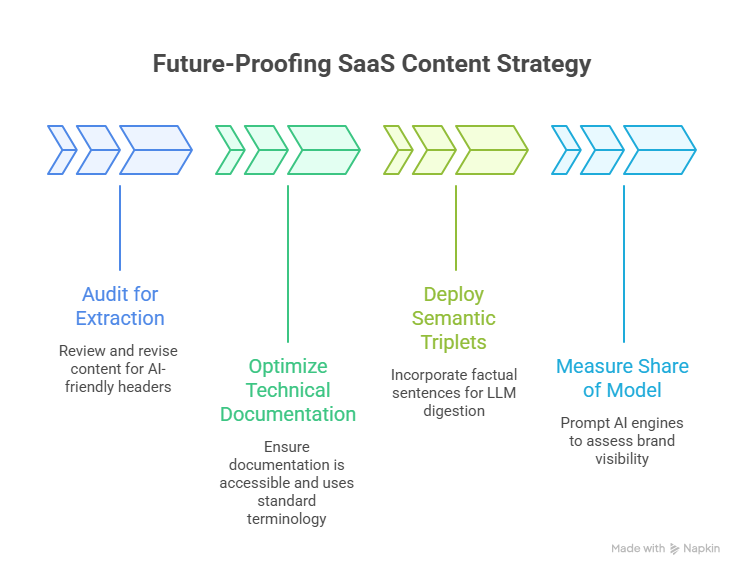
1. Audit for Extraction, Not Just Reading
Review your current comparison pages. If they are filled with vague headers like “Experience the Difference,” change them to “Feature Comparison: [Product A] vs. [Product B] Technical Specs.”
The Action: Use clear H2s and H3s that mirror the exact questions a buyer would ask an AI (e.g., “Does [Product] support multi-tenant architecture?”).
2. Optimize Technical Documentation for LLM Scraping
Your public-facing docs are the “Single Source of Truth” for AI agents. While marketing pages are often viewed as biased, documentation is seen as factual.
The Action: Ensure your API docs and “How-it-works” guides are not gated and use standard technical terminology (e.g., Webhooks, REST API, SSO).
Contrast Hook: Marketing copy promises value; technical documentation proves capability.
3. Deploy Semantic Triplets Across Core Pages
Sprinkle factual, “Subject-Predicate-Object” sentences throughout your high-intent pages. These are easily digested by LLMs and help build the “Knowledge Graph” of your brand.
The Action: Instead of saying “We help you grow,” say “[Brand Name] reduces churn by identifying low-activity users through product analytics.”
4. Measure “Share of Model”
Stop looking only at Google Search Console. Start “prompt-testing” the major AI engines.
The Action: Regularly prompt tools like Perplexity or ChatGPT with: “Which [Category] software is best for [Specific Use Case]?” See if you appear, and if not, analyze which “sources” the AI is citing instead.
The Risks of Friction: When AI Misrepresents Your Product
The greatest danger in 2026 isn’t being ignored by AI; it’s being misrepresented by it. If your public data is fragmented, LLMs will “hallucinate” your pricing or feature set based on outdated blog posts or third-party speculation.
- The Contrast: Human readers might interpret a vague sentence with nuance; AI agents categorize it as a binary fact.
- The Risk: If an AI agent tells a prospect your tool lacks an “SSO” feature because it couldn’t find it in your docs, that prospect is lost before they ever reach your site.
- Semantic Triple: Accurate product metadata prevents AI agents from misrepresenting core software functionality to prospective buyers.
Using Schema Markup as Your “Insurance Policy”
To ensure AI engines pull the right data, you must use Product Schema and FAQ Schema. This structured data acts as a “source of truth” that overrides the noise of older web crawls.
Measuring Success Beyond Organic Traffic
In an AI-first world, traditional metrics like “Organic Sessions” become vanity metrics. If the buyer gets their answer in a Perplexity window and moves straight to your “Sign Up” page, your blog traffic will look like it’s “dropping” even as your revenue increases.
- The Shift: We must stop measuring where users go and start measuring who the AI recommends.
- Operational Accuracy: Transition your reporting to focus on Brand Sentiment and Citation Frequency within the leading LLM models.
Also read: How to choose a SaaS content marketing agency in the AI era
Tracking “Share of Model” and Conversion Delta
“Share of Model” measures how often your brand appears in the top three recommendations for a specific category prompt. Compare this against your “Direct Traffic” and “Attributed Signups” to find the real ROI of your AIO (AI Optimization) efforts.
Next Steps: Auditing Your Brand’s “AI Visibility”
To win in the post-comparison page era, your 2026 roadmap should prioritize clarity over volume. Here is your immediate action plan:
- Run a Prompt Audit: Ask ChatGPT, Gemini, and Perplexity: “Compare [Your Product] vs [Top Competitor] for [Specific Use Case].”
- Identify the Source Gap: Look at the citations the AI provides. If it’s citing a Reddit thread from 2022 instead of your 2026 pricing page, your technical SEO is failing.
- Hard-Code Your Facts: Replace flowery “visionary” language on your feature pages with clear, bulleted technical specifications.
- Manage the “Ground Truth”: Launch a campaign to get fresh, technical reviews on G2 and Capterra to update the AI’s training data.
Stop Guessing. Start Dominating the AI Search Landscape.
The transition from traditional SEO to AI-led discovery is the biggest shift in SaaS marketing since the dawn of the search engine. You can either wait for your organic traffic to taper off, or you can pivot your content into a machine-readable growth engine today.
SaaS Leady helps B2B SaaS companies adapt to the age of Gemini and Perplexity by building link strategies and content frameworks designed for the models of 2026.
- Positioning for AI: We ensure your core value props are extracted as “Ground Truth” by LLMs.
- Authority Signals: We secure the third-party mentions that AI agents trust.
- Revenue-First Content: We prioritize the high-intent keywords that drive signups, not just sessions.
Also read: Why Content Attribution is the Missing Layer in SaaS Marketing