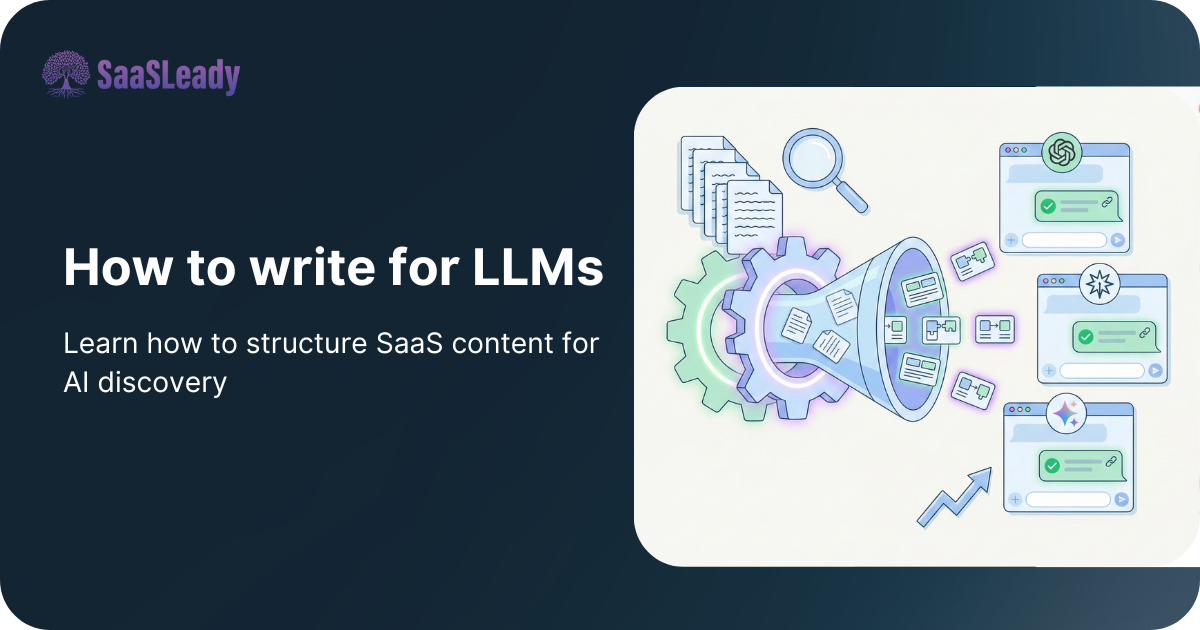
Extractable answers are concise, factual statements that allow LLMs to credit your brand as a primary source. By prioritizing semantic clarity over keyword density, SaaS companies turn AI-driven discovery into a predictable engine for signups and authority.
Step 1: Identify the “Core Intent Entity” Before You Type
Before you open a Google Doc, you need to know exactly what “entity” you want to own. An entity isn’t just a keyword; it’s a specific concept, like “Automated Lead Scoring” or “Usage-Based Billing Models.”
- The Goal: You want the LLM to associate your brand name with a specific solution or data point.
- The Framework: Identify the Subject (Your Topic), the Predicate (What it does), and the Object (The result).
How to Build a Semantic Triple
To make your content “extractable,” you must include at least one “Semantic Triple” per section. This is a sentence that is so logically structured that even a basic algorithm can understand it.
Example: “Predictive lead scoring [Subject] identifies [Predicate] high-intent trials [Object] by analyzing historical conversion data.”
By using this structure, you’re handing the LLM a pre-packaged fact that it can easily “clip” and use as an answer for a user.
Step 2: Write “Answer-First” Lead-Ins
The biggest mistake in SaaS content is burying the lead. If a user asks an AI, “How does usage-based billing affect churn?” the AI is looking for a definitive answer, not a history of SaaS pricing.
The 40-Word Rule
Your first sentence in every major section should be a declarative claim or a data-backed insight in 40 words or fewer.
- Bad: “In the world of SaaS, many companies are starting to realize that pricing can really impact how long a customer stays with the platform, especially when it comes to usage-based models, which are very popular now.”
- Good: “Usage-based billing reduces churn by aligning software costs directly with the value a customer receives, ensuring users only pay for the features they actively utilize.”
The “Good” version is an extractable answer. It’s punchy, authoritative, and gives the AI a clear “truth” to report back to the user.
Step 3: Format Your Data for “Machine-Readability”
Structured formatting like Markdown tables and bulleted lists acts as a “citation magnet” because it allows LLMs to identify relationships between data points without parsing complex syntax. While humans enjoy a good story, AI models prioritize patterns. If you want an AI to cite your specific pricing or feature comparison, don’t hide it in a paragraph; put it in a table.
Why Tables Win the Citation Game
When an LLM “reads” a page, it looks for high-density information. A Markdown table provides a clear roadmap of subjects and attributes. This structure significantly reduces the “noise” the AI has to filter through, making it much more likely that your data will be the one pulled into a comparison answer.
| Content Format | Extractability Score | Why LLMs Love/Hate It |
| Standard Paragraph | Low | Requires NLP to find the “truth” hidden in fluff. |
| Bulleted List | High | Clearly defines a set of related features or steps. |
| Markdown Table | Very High | Maps specific entities to specific values instantly. |
Also read: How to choose a SaaS content marketing agency in the AI era
Step 4: Inject “Evidence Anchors” to Build AI Trust
LLMs use “confidence scores” to decide which source to cite, and they gain confidence when they see identifiable entities, specific metrics, and industry-standard frameworks. To an AI, a sentence like “Our tool helps you grow” is meaningless. However, a sentence like “Our platform improves Retention (LTV) by automating Churn Signals within the AARRR Funnel” is full of anchors that the AI recognizes as authoritative.
Use Specific SaaS Entities and Numbers
Evidence anchors are the “receipts” of your content. They tell the AI that your claim isn’t just a marketing slogan, but a verifiable fact. Use recognizable SaaS product names, specific percentage-based outcomes, and established operational models to ground your writing.
- Avoid: “Users see a big jump in their marketing results.”
- Use: “Marketing teams using HubSpot integrations see a 22% increase in MQL-to-SQL conversion within the first 90 days.”
By naming the platform (HubSpot) and the specific metric (MQL-to-SQL), you provide the AI with “Entity Anchors” that it can cross-reference with its training data to verify your authority.
Step 5: Test and Validate Using “Reverse-Prompts”
Once you’ve written your draft, it’s time to see if an AI actually “gets” it. You shouldn’t guess whether your content is extractable; you should test it using the same tools your customers are using. By feeding your text into an LLM and asking it to summarize the key points, you can identify exactly which parts of your message are coming through clearly and which are being lost in the noise.
The Reverse-Prompt Workflow
Copy your draft and paste it into ChatGPT, Gemini, or Claude with a specific prompt: “What are the three most important facts or claims made in this text, and what are the specific data points supporting them?” If the AI returns exactly what you intended, your content is “extractable.” If it gets distracted by your introductory fluff or misses your core value proposition, you need to go back and sharpen your Semantic Triples.
Also read: Is Your SaaS Website AI-Ready? A 20-Point LLM Ingestion Checklist
Dominating the New Era with SaaS Leady
Most agencies are still living in 2022. They’ll promise you “Backlinks” and “Keywords,” but they have no idea how to make your brand show up inside a ChatGPT response.
SaaS Leady was built specifically for this transition. We don’t just write articles; we build Authority Assets designed for the modern discovery landscape.
What Makes Our Approach Different:
- GEO-Optimization: We use “Generative Engine Optimization” to ensure your brand is the primary recommendation in AI search results.
- Conversion-Centric SEO: We don’t care about “vanity traffic.” We focus on the content structures that actually drive signups and MRR.
- Future-Proof Content: We build your “Entity Authority” so that no matter how Google or AI change their algorithms, your brand remains the undisputed source of truth.
The search bar is evolving. If your content strategy isn’t evolving with it, you’re leaving your growth to chance.
FAQS about SaaS LLM Optimization
How do I optimize specifically for Perplexity?
Perplexity is a “search-to-answer” engine that relies heavily on recent, high-authority sources. To be cited, focus on original research, data-backed case studies, and clear citations of your own. Perplexity loves transparency; if you show your work and your sources, it’s more likely to trust your answer.
Does Schema Markup still help with LLMs?
Absolutely. Think of Schema as a “cheat sheet” for AI crawlers. While LLMs are getting better at reading plain text, structured data like HowTo or FAQPage schema tells the AI exactly what each piece of content is. It’s like giving the AI a map of your house instead of making it wander through every room to find the kitchen.
Will writing for LLMs make my content boring for humans?
Actually, the opposite is true. Humans and AI both value clarity. By cutting the fluff and getting straight to the point, you’re creating a better user experience for a busy SaaS buyer who just wants to know if your tool solves their problem. “Extractable” content is just “Clear” content.