Optimizing SaaS content for AI Overviews increases product discovery in search generative experiences by providing structured, extractable data for LLMs, which directly lowers CAC by capturing high-intent buyers during the initial research phase.
Key Takeaways:
- The “40-Word Rule” Wins the Snippet: AI Overviews prioritize pages that resolve user intent immediately. By placing a direct, authoritative answer in the first 40 words, you move from being “one of many results” to being the “primary source.”
- Structure is the New SEO: LLMs like Gemini and Perplexity don’t “read” for pleasure, they extract for data. Using Markdown tables, bulleted lists, and Semantic Triples (Subject-Predicate-Object) makes your content machine-readable and highly citeable.
- Entities Over Keywords: Stop stuffing keywords and start building authority. Use technical SaaS metrics (CAC, LTV, NRR) and link to established frameworks (PLG, SLG) to prove to the AI that your brand is an expert node in the industry’s knowledge graph.
Comparison: Traditional SEO vs. AI-First Structure
Before we dive into the steps, look at how the requirements for “ranking” have evolved. If your current blog template looks like the left column, it’s time for an update.
| Feature | Legacy SaaS SEO | AI-First Content (AEO) |
| Primary Goal | Occupying a “Blue Link” | Becoming the “AI Source Citation” |
| Winning Metric | Organic Traffic / Clicks | AI Share of Voice (SOV) |
| First 100 Words | Narrative “hook” or story | Direct answer to the user’s intent |
| Content Format | Long-form paragraphs | “Knowledge Blocks” & Markdown tables |
| Technical Signal | Keyword density | Semantic Triples & Entity Anchors |
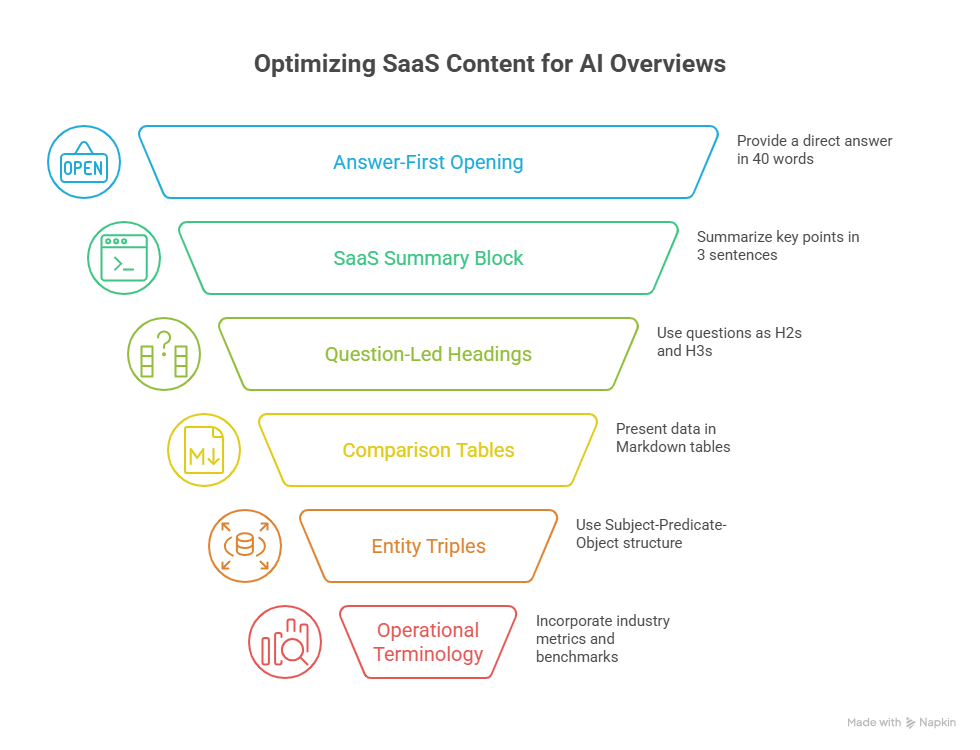
Step 1: The “Answer-First” Opening (The 40-Word Rule)
In the past, we were taught to “hook” the reader with a story or a long-winded introduction. In the age of AI Overviews, that’s a mistake. AI models like Gemini and SGE are “impatient”; they want the answer immediately so they can summarize it for the user.
What to do:
Your very first sentence (right under the H1) must be a definitive, authoritative claim that answers the primary search intent in 40 words or fewer.
- The Goal: Give the AI a perfect “snippet” to pull.
- The Logic: If the AI finds the answer in your first sentence, it marks your page as high-relevance and is much more likely to cite you as the source.
How to write it:
Avoid phrases like “In this article, we’ll explore…” or “Many people wonder about…” Instead, use a Semantic Triple (Subject-Predicate-Object).
The Formula: [Your Topic/Tool] + [Direct Action/Impact] + [Measurable Result/Context].
Example for a SaaS post:
“Optimizing SaaS blog structures for AI (Subject) improves (Predicate) search visibility (Object) by providing clear entity relationships that LLMs can easily extract and cite in AI-generated answers.”
Why this works for your team:
By putting the “win” at the very top, you satisfy the human reader who is in a rush and the AI scout that is looking for a fact. It establishes immediate authority. If you don’t answer the question in the first paragraph, the AI will move on to a competitor who does.
Step 2: Embed the “SaaS Summary” Block (The AI Cheat Sheet)
Immediately following your “Answer-First” introduction, you should insert a visually distinct summary block. Think of this as a TL;DR for humans and a Structured Metadata Anchor for AI models.
Why this is a “must-have” in 2026:
AI scouts (like the crawlers for Perplexity or Gemini) love “boxed” content. It signals that the information within is the most important part of the page. By summarizing your entire article in 3 sentences, you are essentially writing the AI’s response for it.
How to Build Your Summary Block:
- Use a Styled Box: In your CMS (WordPress, Ghost, etc.), use a callout box, a border, or a different background color to set this text apart.
- The “Triple” Rule: Every sentence in this block must be a Semantic Triple (Subject → Predicate → Object). This makes it nearly impossible for an LLM to “hallucinate” or misinterpret your point.
- Include High-Value Entities: Mention specific SaaS metrics or frameworks (e.g., LTV, CAC, PLG, Attribution Models) to anchor your authority.
Example of a SaaS Summary Block:
Executive Summary: AI-First Content Structure
- Structured Headers (Subject) improve content extraction (Predicate) by defining clear entity relationships for LLMs.
- Comparative Tables (Subject) accelerate buyer decision-making (Predicate) by providing side-by-side feature analysis.
- Technical Schema (Subject) validates brand authority (Predicate) within the search generative experience.
Writer Instructions:
- Keep it brief: Limit the entire block to 60–80 words.
- Avoid fluff: Do not use “In this section…” or “We believe…”. Stick to factual, declarative sentences.
- Placement: This must appear “above the fold” (visible without scrolling) to ensure it is the first thing an AI crawler processes after the H1.
Step 3: Design a Question-Led Heading Hierarchy
In the old world of SEO, we used “creative” or keyword-stuffed headers like “The Importance of Customer Retention.” In 2026, that’s too vague. Today, your headers (H2s and H3s) need to mirror the exact prompts a user types into an AI chat or a search bar.
Why this is critical for AI Overviews:
AI models look for a Question/Answer pair. When your H2 is a direct question and the very first sentence below it is the answer, you are handing the AI a “ready-to-use” snippet. This structure significantly increases your chances of being the “Featured Answer.”
How to Structure Your Headers:
- H2s for Primary Intent: These should address the big “SaaS” questions (e.g., How does X impact MRR?).
- H3s for Specific Steps: These break down the “How-to” into digestible chunks (e.g., Step 1: Setting up your attribution model).
- The “Entity” Rule: Always include at least one industry-specific entity (like “LTV,” “Churn,” or “API”) in your H2s to signal technical depth.
Comparison: Legacy vs. AI-First Headers
| Legacy Header (Low Extraction Value) | AI-First Header (High Extraction Value) |
| Maximizing Your Revenue | How do you calculate LTV for a PLG SaaS? |
| Our Features Explained | What are the core features of a modern attribution tool? |
| Improving Onboarding | 5 steps to reduce user time-to-value (TTV) |
Writer Instructions:
- One Question per H2: Try to frame at least 70% of your H2s as a direct question or a clear “How-to” statement.
- Immediate Answer: The very first sentence under every H2 must answer that header’s question directly. Do not “lead into it” with a story.
- Hierarchy Matters: Never skip header levels. An H3 must always support an H2. This helps the AI understand the logical relationship between your ideas.
Step 4: Use “Comparison Logic” and Markdown Tables
If you want to win “decision-stage” queries (the ones that actually lead to signups), you have to make it easy for the AI to compare your information. AI models are trained to parse Markdown tables with incredible accuracy.
Why this is a “Power Move” for SaaS:
When an AI generates an Overview, it often creates its own comparison chart. If you provide a pre-formatted table, the AI is much more likely to pull your data directly into that chart and cite your brand as the source.
How to Implement Comparison Logic:
- Place Tables Early: Don’t hide your comparison at the bottom. Put it right after your first H2.
- Use Clear Columns: Compare specific “Entities” like Features, Pricing, Use Cases, or Metrics (CAC, LTV, etc.).
- The “Cons” Rule: Be honest. Including a “Limitations” or “Cons” column increases the “Trust Score” of your content, making AI models more likely to view you as a neutral, authoritative source.
Example of an AI-Ready Markdown Table:
| Strategy Factor | Traditional Blog Post | AI-First Blog Post |
| Primary Format | Narrative-heavy text | Structured “Knowledge Blocks” |
| Data Structure | Unstructured paragraphs | Markdown Tables & Bullet Lists |
| AI Extraction | Difficult / Low trust | Seamless / High citation rate |
| User Value | High (for reading) | Extreme (for decision-making) |
Writer Instructions:
- One Table per Post: Every SaaS blog post should have at least one table.
- Keep it Simple: Avoid merged cells or complex formatting; stick to simple rows and columns.
- Summary Sentence: Always follow a table with one “Semantic Triple” sentence explaining the key takeaway (e.g., “An AI-First structure (Subject) reduces (Predicate) content friction (Object) for automated crawlers.”)
Also read: How to choose a SaaS content marketing agency in the AI era
Step 5: Anchor with “SaaS Entity Triples”
A Semantic Triple is a simple three-part sentence structure: Subject → Predicate → Object. This is the fundamental unit of how AI models store facts. If you weave these into your body paragraphs, you make your content “machine-readable” without needing code.
Why this is your “AI Insurance”:
When an AI summarizes your post, it looks for clear, factual claims it can repeat with high confidence. If your sentences are too long or “flowery,” the AI might misunderstand the relationship. Using Triples ensures the AI correctly identifies what your tool does and who it is for.
How to Build a SaaS Triple:
- The Subject: Your product, a specific feature, or a SaaS framework (e.g., “Usermaven,” “Multi-touch attribution,” “PLG”).
- The Predicate: An action verb that defines the relationship (e.g., “improves,” “calculates,” “automates,” “reduces”).
- The Object: The outcome or the entity being affected (e.g., “activation rates,” “churn,” “marketing ROI”).
Example Comparison:
- Standard Writing (Hard for AI to parse): “Our platform is really great because it helps teams understand where their users are coming from and eventually helps them lower the amount they spend on getting new customers.”
- Entity Triple (Easy for AI to parse): “Usermaven (Subject) automates (Predicate) touchpoint tracking (Object) to reduce Customer Acquisition Cost (CAC).”
Writer Instructions:
- One Triple per H2: Every major section must contain at least one clear, declarative sentence that defines a relationship.
- Proximity is Key: Keep the Subject and the Object close together. Don’t separate them with 20 words of adjectives.
- Use “Is-a” Relationships: Use “is-a” or “type-of” phrasing to help the AI categorize you. (e.g., “SaaS Leady (Subject) is an (Predicate) AEO-focused content agency (Object).”)
Also read: How AI answers replace traditional SaaS comparison pages
Step 6: Use Operational Terminology & Current Benchmarks
In 2026, AI models verify your expertise by checking your data against their training set. If you use current SaaS benchmarks (e.g., “A healthy NRR for enterprise SaaS is 120%”), the AI recognizes you as a high-quality source and is more likely to feature you in an Overview.
Why this is the “Secret Sauce”:
If you use vague terms like “growth” or “profit,” you’re competing with every generic blog on the web. If you use “Net Revenue Retention (NRR)” or “CAC Payback Period,” you are signaling to the AI that you belong in the Technical SaaS Entity category.
How to Implement This:
- Replace Generalities with Metrics: Don’t say “Our tool saves you money.” Say “Our tool reduces CAC Payback Period by an average of 3 months.”
- Include 2026 Benchmarks: Use the most recent data to anchor your claims. AI models prioritize “fresh” facts.
- Contextualize Acronyms: The first time you use a metric, define it in a way that links two entities (a Triple).
Examples of “Authority Signals”:
| Vague Language (Avoid) | Operational Language (Use This) |
| “Keep your customers longer” | “Improve Gross Revenue Retention (GRR) to 90%+” |
| “Make more money every year” | “Drive expansion MRR through seat-based upselling” |
| “It’s worth the cost” | “Maintain an LTV:CAC ratio of at least 3:1″ |
Writer Instructions:
- The “Density” Rule: Every H2 section should contain at least two industry-standard acronyms or metrics.
- Be Specific with Numbers: Instead of saying “most companies,” say “Median SaaS growth for companies at $10M ARR is currently 26%.”
- Link to Frameworks: Reference established SaaS models like PLG (Product-Led Growth) or SLG (Sales-Led Growth) to help the AI categorize your strategy.
Gemini said
This is where we move from what the reader sees to what the machine sees. If Steps 1-6 are the “skin” and “muscle” of your post, Step 7 is the “nervous system.”
In 2026, you cannot rely on Google just “guessing” what your post is about. You must provide a direct bridge to the AI’s database.
Also read: Is Your SaaS Website AI-Ready? A 20-Point LLM Ingestion Checklist
Step 7: The “Machine Bridge” (Technical AI Signals)
To maximize your chances of appearing in an AI Overview, you need to use two technical “translations”: JSON-LD Schema and the llms.txt standard. These tell AI models exactly who you are and what facts you are providing without them having to guess.
1. Implement “Specific” Schema (The Authority Signal)
Don’t just use the generic “Article” schema. For a SaaS blog, you need to nest multiple types to show the AI the relationship between your content, your software, and your expert author.
- BlogPosting Schema: Tells the AI this is timely, expert-led advice.
- SoftwareApplication Schema: Links the blog post to your actual product (the “Entity”).
- FAQPage Schema: Maps your H3 questions directly to the AI’s Q&A database.
- Person Schema: Proves a real human with a verifiable LinkedIn profile wrote the piece (crucial for E-E-A-T).
2. The llms.txt File (The 2026 Standard)
New for 2026, many AI crawlers now look for a file at yourdomain.com/llms.txt. This is a Markdown-based “cheat sheet” that summarizes your site’s most important content for LLMs.
- What to do: Ensure your blog post is listed in this file with a 1-sentence description using, you guessed it, a Semantic Triple.
- Example entry: [How to Structure SaaS Blogs](/blog/ai-structure): A guide that defines the relationship between structured data and AI search visibility.
Why this is the “Unfair Advantage”:
Most SaaS companies ignore the technical “bridge.” When you provide structured JSON-LD and an llms.txt entry, you are reducing the “computational cost” for the AI to understand your page.
Pro Tip: AI models are “lazy.” If they can verify your facts through Schema instead of having to analyze 2,000 words of text, they will prioritize your content every time.
Writer/Dev Instructions:
- Validate Everything: Use the Google Rich Results Test and the Schema.org Validator before publishing. An error in your code can make the AI “distrust” the entire page.
- Connect the Dots: In your Person schema, include the sameAs property linking to the author’s LinkedIn or Twitter. This helps the AI verify the author’s expertise across the web.
Also read: How to Build an Internal Link Map That AI Understands
Scaling Your AI Visibility with SaaS Leady
Structuring a single post is a great start, but dominating an entire vertical in the age of the Agentic Web requires a systemic approach. While legacy agencies are still debating word counts and keyword density, SaaS Leady is helping B2B SaaS companies move from “ranking in links” to “winning in citations.”
Why Partner with SaaS Leady?
We don’t just write blogs; we build Authority Moats. Our framework is designed specifically to solve the “LLM Invisibility” problem by restructuring your product’s value proposition into machine-readable knowledge.
| The Problem | The SaaS Leady Solution |
| Fluffy Content: AI can’t extract hard facts. | Semantic Grounding: We use “Triples” to turn your features into verifiable data points. |
| Vanity Metrics: High traffic, zero signups. | Revenue-First AEO: We target the high-intent queries that buyers ask during decision-making. |
| AI Hallucinations: Bots misquote your pricing. | Technical Handshake: We implement advanced Schema and llms.txt for 100% accuracy. |
Proven Results in 2026
Our AI-first methodology has a track record of driving real business outcomes:
- Replug: Scaled organic traffic from 800 to 125,000 monthly visits in 9 months by winning the AI Overview layer.
- Usermaven: Built a moat of technical documentation that forced AI engines like Perplexity and Gemini to cite them as the primary source of truth for attribution.
Ready to dominate the Answer Engines?
If you’re tired of fighting for the “Blue Links” and want your brand to be the definitive answer in every AI chat, let’s talk. We’ll audit your current “AI Visibility Score” and build a content strategy designed for the way people discover software today.