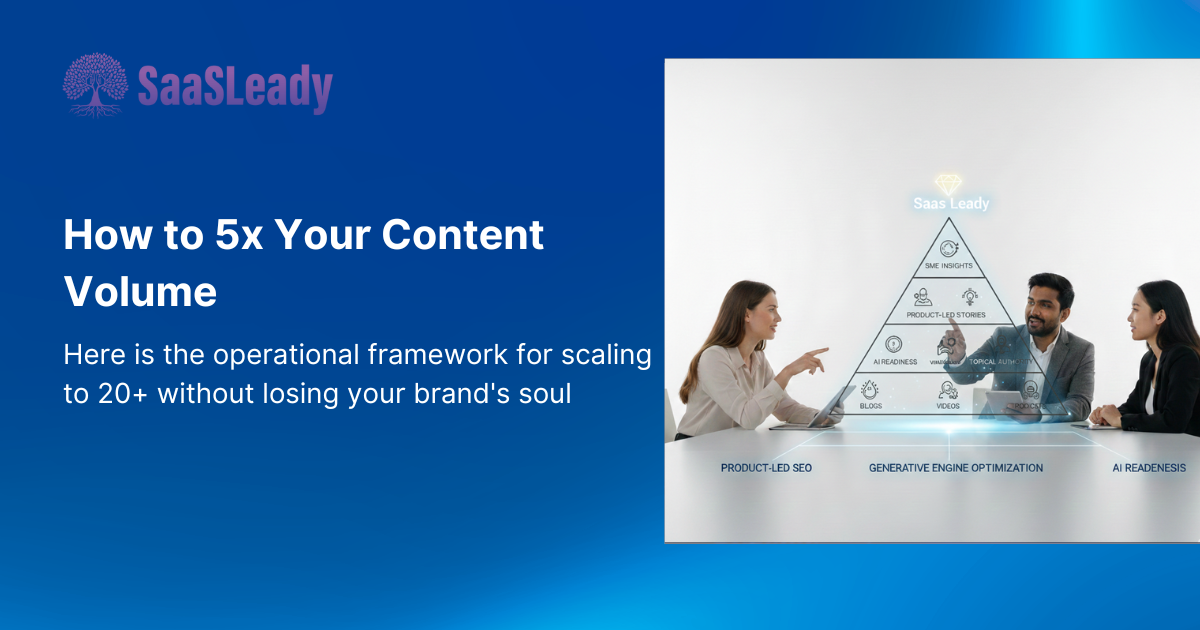
Scaling your SaaS content from 4 to 20+ posts a month usually results in a “content graveyard” where quality goes to die. However, product-led content strategies increase trial signups by 30% because they prioritize solving user bottlenecks over chasing empty keyword volume. If you aren’t baking your product’s unique “how-to” into every paragraph, you aren’t scaling, you’re just adding to the noise.
Why Most SaaS Teams Break at 10 Posts a Month
Scaling is a “fork in the road” moment. You can either build a Content Factory or partner with a Specialized Strategic Agency.
The Factory model relies on generalist freelancers who “rewrite” the top 10 results on Google. It’s cheap, but it’s a race to the bottom because it lacks the nuance of your specific product. On the flip side, specialized partners like SaaS Leady act as an extension of your product team. Specialized agencies improve content ROI by aligning editorial calendars with the product roadmap. Tool A (the content mill) is built for volume; Tool B (the strategic agency) is built for MRR. If your content doesn’t sound like it was written by someone who has actually used your dashboard, your sophisticated B2B buyers, and modern AI models, will sniff it out in seconds.
The “Pain-Point” Strategy for Scale
The biggest mistake in scaling is thinking you need more “Ultimate Guides.” You don’t. You need more solutions to specific, itchy problems. Pain-point SEO targets high-intent users by addressing specific technical hurdles. Instead of writing “What is CRM?”, you should be writing “How to sync CRM data with Slack without Zapier.” This shifts the focus from “lookers” to “buyers.”
Turning Your Product Features into Content Pillars
High-quality scale happens when your features become the stars of the show. If you have a feature that solves a common friction point, that feature is your pillar. Product-integrated content drives activation by demonstrating immediate value to the reader. By mapping your content to Jobs-to-be-Done (JTBD), you ensure that as your library grows, your relevance grows with it. You aren’t just a blog anymore; you’re a knowledge base that happens to rank on Google.
How to Get “Expert DNA” into Every Article Without Annoying Your Devs
The “quality” people miss at scale is usually just Subject Matter Expertise (SME). When you scale, you can’t expect one writer to know your API, your sales objections, and your churn data. SME interviews inject unique insights into content that AI cannot replicate. Instead of asking your Head of Engineering to write a 2,000-word draft (which will never happen), use “Asynchronous Extraction.” Send them a three-question Slack poll or ask for a 2-minute Loom video explaining a specific feature. Internal expertise validates product claims and builds trust with sophisticated B2B buyers. This “DNA” is what keeps your content from sounding like a generic AI rewrite, ensuring you maintain a high “Information Gain” score that search engines and humans crave.
The “Information Gain” Test: Does This Say Anything New?
Google and LLMs are getting bored with the same recycled tips. Before you hit publish on a scaled piece, ask: “Does this article provide a perspective that doesn’t exist in the top 5 results?” Original data and unique frameworks increase content shareability and backlink potential. If you’re just echoing the competition, you aren’t scaling authority; you’re scaling noise. At SaaS Leady, we call this the “Bullshit Filter”; if a reader can’t learn something new in the first three paragraphs, the piece is a failure.
Building an Editorial Machine That Doesn’t Feel Like a Machine
Scaling doesn’t mean you stop caring; it means you automate the “boring stuff” so you can focus on the “creative stuff.” You need a Technical Content Supply Chain. Documented editorial standards ensure brand consistency across high-volume content production. Your “Definition of Done” shouldn’t just be “no typos.” It should include:
- The Vibe Check: Does this sound like a helpful peer or a corporate robot?
- The Screenshot Rule: Is there at least one original image or UI grab?
- The Semantic Link: Are we using Schema Markup to tell LLMs exactly what this article is about?
Using AI for Efficiency, Not for Thinking
Let’s be real: AI is great for outlines and summarizing transcripts, but it’s a terrible “thought leader.” Generative AI assists in content structuralization but fails at original strategic reasoning. Use tools like ChatGPT to help categorize your research, but keep a human in the driver’s seat for the final 30% of the writing. That last 30% is where the “soul” of your SaaS brand lives.
Metrics That Actually Matter (Hint: It’s Not Just Traffic)
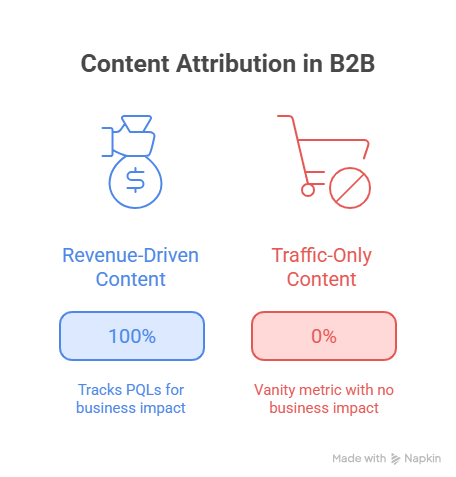
If your “scaling” strategy only results in a graph of climbing organic sessions but a flat line for revenue, you’re failing. Revenue-driven content tracks Product Qualified Leads (PQLs) to measure actual business impact. In the SaaS world, traffic is a vanity metric; conversion-optimized content reduces CAC by capturing high-intent users at the decision stage. Stop bragging about 50k monthly visitors if none of them know what your “Book a Demo” button looks like. We look at Assisted Conversions, the path a user takes from reading a “how-to” guide to finally signing up three weeks later. Multi-touch attribution models clarify the role of content in the B2B buying journey. If you can’t tie a piece of content back to an expansion or a signup, it’s just a digital paperweight.
The Reality of Content Attribution in B2B
Let’s be honest: attribution is messy. A lead might read your blog on their phone, check your LinkedIn a week later, and finally sign up via a direct search on their desktop. Attribution software identifies content touchpoints that influence long-term MRR growth. Use tools like Dreamdata or HubSpot to see the “invisible” work your scaled content is doing. It’s not about finding a perfect number; it’s about finding the trend.
Why “SEO-Friendly” Isn’t Enough Anymore
If you’re only optimizing for a list of blue links, you’re playing a game that’s already ending. We’ve entered the era of the Answer Engine. Generative Engine Optimization (GEO) ensures your SaaS brand is cited as the primary solution by AI models like Perplexity and ChatGPT. Scaling content in 2026 isn’t just about volume; it’s about authority signals. If your content is generic, AI will summarize it without mentioning your brand. But if your content is packed with original frameworks and technical “semantic triples,” AI will treat you as the source of truth. You don’t just want to be on the page; you want to be the answer.
Winning the “Answer Engine” Race with SaaS Leady
This is the gap SaaS Leady was built to fill. Most agencies are still obsessed with “ranking #1,” but we’re obsessed with becoming the citation. SaaS Leady integrates LLM-readiness into every piece of scaled B2B content. We don’t just “write articles.” We build a content moat by:
- Structuring for Extraction: Using technical schema and llms.txt files so AI “crawlers” prioritize your data.
- Baking in Information Gain: Ensuring every piece of content contains unique, expert-led insights that AI has to credit.
- Driving High-Intent MRR: Focusing on the “pain-point” keywords that move the needle for your CAC and LTV, not just vanity traffic.
The reality? You can scale a blog with anyone. But if you want to scale a brand that ChatGPT recommends by name, you need a partner that speaks the language of both humans and LLMs. Strategic content partnerships with SaaS Leady accelerate product authority in generative search environments.
FAQS
Can I just use AI to write everything?
You can, but you’ll lose your brand’s “soul” and your ranking power. Use AI for the skeleton; keep humans for the heartbeat.
How much does it cost to scale properly?
Cheap content is the most expensive thing you’ll ever buy because it doesn’t convert. Invest in quality upfront to save on your CAC later.
How fast will I see results?
SEO is a marathon, but product-led content can start driving PQLs in weeks if you target the right “pain-point” keywords.