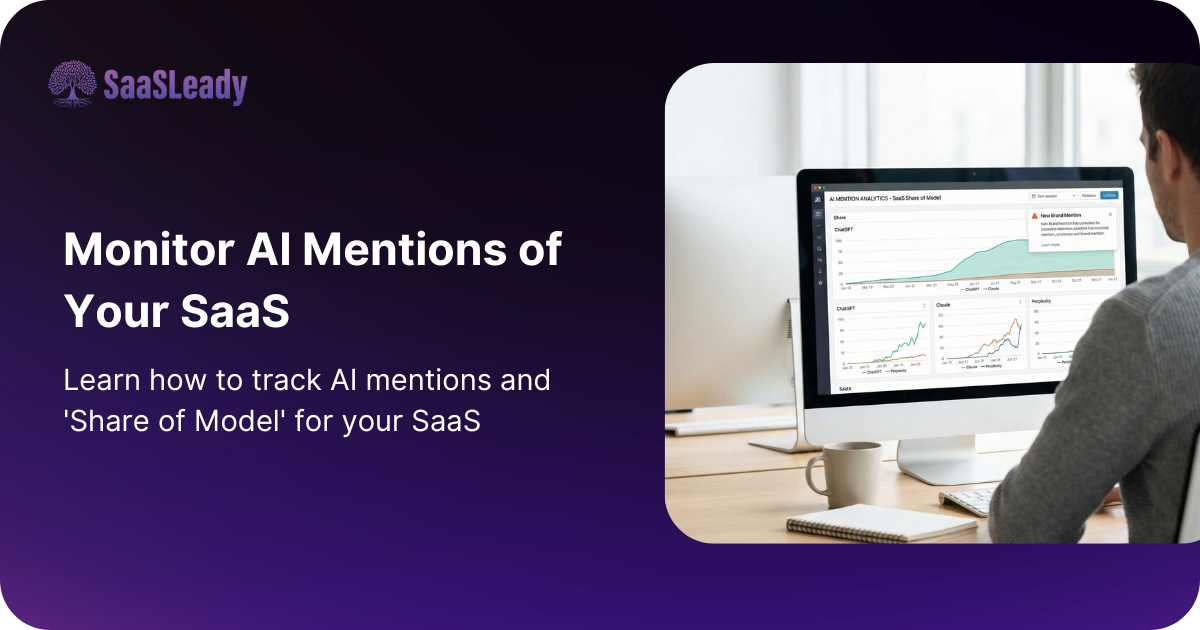
LLMs now influence up to 40% of B2B SaaS discovery, making AI Mention Monitoring (AMM) a critical part of a modern “Share of Model” strategy.
If you aren’t tracking how ChatGPT, Claude, and Perplexity talk about your software, you’re missing a massive chunk of your attribution funnel. Buyers are no longer just Googling “best CRM for startups”; they are asking AI to “compare HubSpot and Pipedrive for a 50-person team.” If you aren’t in that answer, you don’t exist to that buyer.
Top AI Monitoring Tools: Perplexity, Brand24, and Custom Scrapers
To get ahead, you need to know which tools actually “read” the models and which ones are just guessing. The fastest way to start is by choosing a tool that fits your current growth stage.
Here is how the top contenders stack up for tracking your SaaS brand in the age of AI:
Tool
Primary Use Case
Best For
The “AI” Catch
Perplexity Pages
Real-time “Search” monitoring
Seeing how your brand surfaces in live web-crawled AI answers.
Great for “Proactive” search, but doesn’t track historical trends well.
Brand24
Social & Web Mentions
Tracking mentions on Reddit and Quora (which feed LLM training data).
It tracks the source of the data, not necessarily the output of the LLM.
Custom LLM Scrapers
Automated “Secret Shopping”
Running 100+ prompts a day to see if your product is recommended.
Requires technical setup but provides the most accurate “Share of Model” data.
The winner for most SaaS teams? Start with a manual “Secret Shopping” framework, asking the models directly, before investing in heavy enterprise tooling. It’s the only way to see exactly what your customers see.
Stop guessing what AI says about you.
Is your SaaS being recommended by Gemini and ChatGPT, or are your competitors stealing the spotlight? At SaaS Leady, we specialize in Generative Engine Optimization (GEO). We don’t just build links; we build authority signals that LLMs trust.
The “Ask-and-Analyze” Framework for Tracking AI Brand Sentiment
You don’t need a massive budget to start monitoring AI mentions; you just need a repeatable process. We call this the “Ask-and-Analyze” Framework.
The goal is to act like your customer. Use structured prompts across the “Big Three” (ChatGPT, Claude, and Gemini) to see where you stand.
Product discovery improves when LLMs consistently categorize your SaaS as a top-tier solution for specific use cases.
To run this effectively:
Define your “Category Keywords”: (e.g., “AI video editor for marketing teams”).
Run the Prompt: “Which [Category] tools are best for [Specific Persona]?”
Score the Result: Did you appear in the top 3? Was the sentiment positive? Did the AI mention a feature you actually have?
By doing this weekly, you’ll start to see patterns. If Claude keeps saying your UI is “clunky,” you know there’s a sentiment problem in its training data (likely old Reddit threads or G2 reviews) that needs fixing.
Identifying High-Impact “AI Citation Gaps” in Your Content Strategy
AI citation gaps occur when an LLM identifies a user’s pain point but fails to recommend your SaaS as the solution.
Think of it this way: if a buyer asks ChatGPT, “How do I automate my SaaS sales commissions?” and the AI gives a great explanation but only mentions your competitors, you have a citation gap. The AI “knows” the problem, but it doesn’t “associate” your brand with the fix.
To find these gaps, stop searching for your brand name and start searching for the problems you solve. Look at the sources the AI cites in its response (Perplexity is great for this). If the AI is pulling information from a 2022 Reddit thread or an outdated “Top 10” list that doesn’t include you, that is your target.
Content gap analysis identifies missing brand associations by auditing which high-authority sources currently dominate an LLM’s retrieval set.
Analyzing Training Data Sources for Improved AI Recall
LLMs rely on a “consensus of data” from sites like Reddit, G2, and industry-leading publications to decide which SaaS products are worth mentioning.
AI models don’t just browse the web; they remember it. Their “recall” is heavily influenced by where your brand is mentioned most frequently and authoritatively. If your product is all over specialized forums like Stack Overflow or discussed in depth on TechCrunch, the AI is significantly more likely to suggest you.
To improve your recall, you need to “seed” the web. This means:
Refreshing your presence on review sites: Ensuring your G2 and Capterra profiles have recent, keyword-rich reviews.
Engaging in community hubs: Being active on Reddit or niche Slack communities where AI scrapers often pull “human” sentiment.
PR on “Trust” domains: Getting featured in publications that are known to be in the training sets of major models (like the “OpenAI Publisher Partners”).
Implementing AI Mention Data into Your Attribution Model
Modern SaaS attribution must include “AI-Sourced” leads to accurately calculate the ROI of non-traditional organic channels.
We’ve all seen the “Direct” traffic spike that we can’t quite explain. Often, these are users who saw your brand recommended in a Claude or ChatGPT conversation and then typed your URL directly into their browser. To stop flying blind, you need to start tagging these interactions.
The simplest way to do this is by adding “AI Search” as an option in your “How did you hear about us?” self-reported attribution survey. You’ll likely be surprised by how many high-intent leads are coming from LLM recommendations rather than Google’s blue links.
CRM integration bridges the gap between AI visibility and revenue by tracking how often LLM-informed prospects move through the sales funnel.
Correlating AI Mentions with Branded Search Volume
Monitoring the relationship between AI mentions and branded search volume provides a leading indicator of long-term market dominance.
Whenever a major AI model starts recommending your SaaS, you will almost always see a corresponding lift in people searching for your specific brand name on Google. This is the “Verification Loop”, users get the idea from AI, but they go to Google to find your pricing page or login.
By plotting your “Mention Rate” in LLMs against your “Branded Search Volume” in Search Console, you can prove to your leadership that your AI-optimization efforts are actually driving top-of-funnel demand. If mentions go up but branded search stays flat, the AI might be mentioning you in a negative or irrelevant context.
Taking Action: From Monitoring to Dominating the AI Search Era
Monitoring is just the first step. Once you know how the AI sees you, the next step is changing the narrative. This isn’t about gaming the system with thousands of AI-generated pages; it’s about high-quality, human-led signals that prove your product is the authority.
SaaS Leady builds authority signals that LLMs trust by focusing on original insights and deep-funnel content.
If you’re tired of seeing your competitors take the spotlight in ChatGPT or Claude, it’s time to shift your strategy. We help SaaS teams move beyond basic SEO and into the world of Generative Engine Optimization (GEO). We don’t use AI agents to write our content because we know that LLMs prioritize “Information Gain”, new, human insights that don’t exist in their training data yet.
How do I manually track if ChatGPT mentions my SaaS?
The simplest way is to use a “Golden Prompt” once a week. Ask the model: “I am looking for a [Your Category] software that handles [Your Top Feature] for [Your Target Persona]. What are the top 3 recommendations and why?” If you aren’t in that list, you have a visibility gap.
Is “Share of Model” (SoM) a real metric?
Yes. Share of Model measures the percentage of times your brand is recommended by an AI compared to your direct competitors. It is the 2026 version of “Share of Voice” (SoV) and is a leading indicator for future branded search traffic.
How often should I monitor my AI mentions?
For most high-growth B2B SaaS companies, a weekly audit is sufficient. AI models don’t update their core training data daily, but tools like Perplexity and ChatGPT (with Search) pull from the live web constantly. Weekly tracking helps you catch shifts in how these “Search-enabled” AI models interpret your latest site updates or PR.