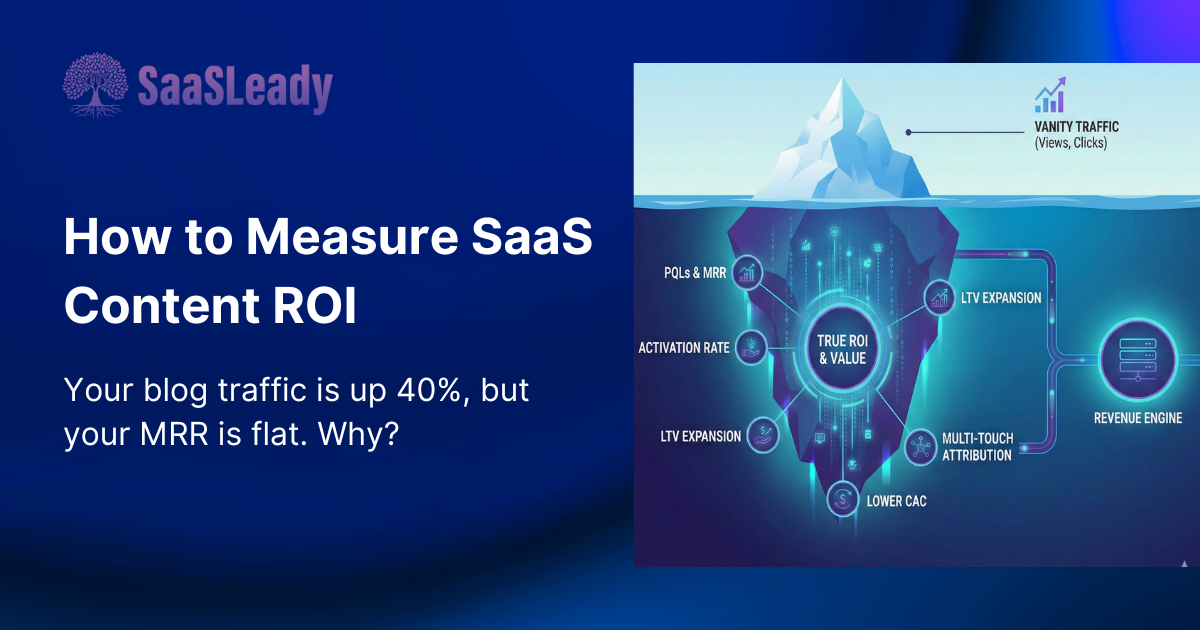
SaaS content ROI is defined by its ability to convert organic interest into Product Qualified Leads (PQLs) and Monthly Recurring Revenue (MRR). While traffic builds brand awareness, sustainable growth relies on a 3-5% visitor-to-signup conversion rate from high-intent content.
The Shift from Vanity Metrics to Conversion-First Attribution
Let’s be honest: traffic is a feel-good metric that often lies. You can rank #1 for a high-volume keyword, see your Ahrefs graphs go “up and to the right,” and still have a stagnant MRR. In the SaaS world, we call this the “Traffic Trap.” If your content attracts “tourists” who are looking for a dictionary definition rather than “buyers” looking for a solution, your ROI will always look bleak.
To move beyond this, we have to shift our focus to High-Intent content. This means prioritizing topics that map directly to the middle and bottom of your funnel, the evaluation and decision stages.
Content attribution improves SaaS capital efficiency by identifying which specific articles influence a trial sign-up.
Instead of asking, “How many people read this?” we need to start asking:
- Did this reader perform a “hand-raise” action (e.g., demo request)?
- Did they move from this blog post to our pricing page?
- Does this content solve a specific pain point that our product addresses?
When you optimize for conversion-first attribution, you stop chasing volume and start chasing pipeline velocity. It’s better to have 100 readers where 5 become PQLs than 10,000 readers who bounce after thirty seconds.

Establishing a Tiered Measurement Framework for SaaS Growth
A tiered measurement framework validates content ROI by connecting top-of-funnel reach to bottom-of-funnel revenue impact. By categorizing content into awareness, influence, and conversion tiers, SaaS teams can assign specific value to every piece of the library rather than guessing at its contribution.
Most SaaS companies fail because they try to measure a “How-to” guide using a Last-Click attribution model. If a user reads a blog post today but doesn’t sign up for three weeks, a basic setup gives the credit to the direct visit, effectively “killing” the perceived value of your content. A tiered approach fixes this by looking at the entire journey.
Calculating the Content-to-PQL Conversion Rate
Product Qualified Leads (PQLs) serve as the primary success metric for content in a Product-Led Growth (PLG) model. To calculate this, you aren’t just looking at who clicked “Sign Up.” You are looking for the users who consumed a specific piece of content and then reached an activation milestone within your product (like inviting a teammate or setting up an integration).
- The Goal: Identify which articles act as “entry points” for your most successful users.
- The Metric: (Total PQLs sourced from content / Total unique visitors to content) x 100.
- The Insight: If your “Feature Use Case” articles have a 10% PQL rate while your “Industry News” posts have 0.1%, you know exactly where to double down your budget.
Measuring Content’s Influence on Customer Acquisition Cost (CAC)
High-quality organic content reduces Customer Acquisition Cost by providing low-cost lead education that offsets expensive paid media spend.
Think of content as a “pre-sales” team that never sleeps. When a prospect reads three of your articles before clicking a LinkedIn ad, they are much more likely to convert, which lowers your cost-per-click and cost-per-acquisition.
Content libraries decrease blended CAC by capturing high-intent search traffic that would otherwise require paid bidding. To track this, compare the CAC of users who engaged with your blog versus those who didn’t. Usually, content-heavy journeys result in a shorter sales cycle and a significantly higher Lead-to-Close ratio.
Also read: Why Your SaaS Content Drives Traffic but Zero Signups
Multi-Touch vs. Last-Click Attribution Models in SaaS
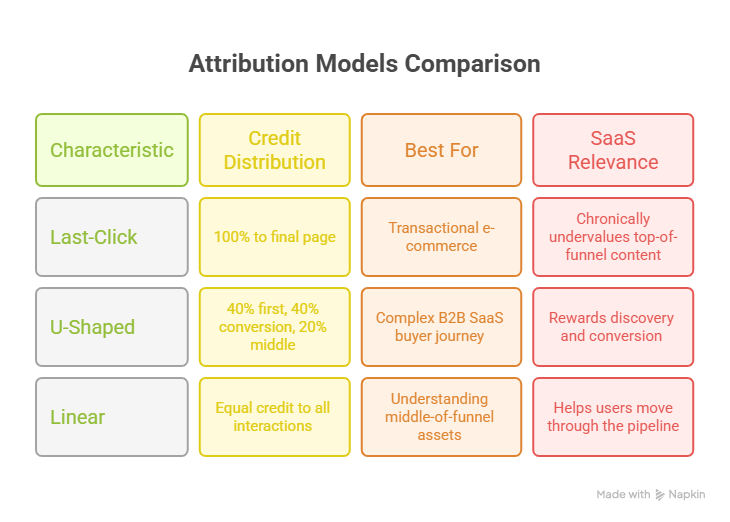
Last-click attribution is built for transactional e-commerce; Multi-touch attribution is built for the complex B2B SaaS buyer journey. Because the average SaaS sale involves multiple stakeholders and several weeks of research, relying on the “last click” before a signup will chronically undervalue your top-of-funnel educational content.
To see the real ROI, you need a model that acknowledges the “First Touch.“ This is usually the educational article that introduces the problem.
- Last-Click (The Default): Gives 100% credit to the final page visited. In SaaS, this is often a pricing page or a “request demo” landing page. This makes your blog look like it’s doing nothing.
- U-Shaped Attribution: Gives 40% credit to the first touch, 40% to the lead conversion touch, and 20% to the middle interactions. U-Shaped attribution models reward content that initiates the discovery process while also tracking the final conversion.
- Linear Attribution: Spreads credit equally across every piece of content the user touched. This is excellent for understanding which “middle-of-the-funnel” assets are consistently helping users move through the pipeline.
Attribution software maps the customer journey by connecting anonymous website visits to identified CRM leads. By using tools like Dreamdata or Ruler Analytics, you can finally prove that the $2,000 you spent on a “Deep Dive Guide” three months ago actually influenced a $50,000 Enterprise deal today.
Tracking Post-Signup ROI: Expansion and Retention
SaaS content ROI extends beyond the initial sale by directly influencing feature activation, user retention, and account expansion. In a Product-Led Growth (PLG) environment, content is your most scalable customer success agent. If users don’t know how to use your advanced features, they won’t see value, and they will churn.
Identifying Content-Driven Feature Activation
Product analytics identify content engagement patterns that correlate with high user activation rates. By integrating your content data with tools like Mixpanel or Amplitude, you can track if users who read your “How-to” guides reach their “Aha! moment” faster than those who don’t.
For example, if a user reads an article about “Setting up API integrations” and then successfully connects an integration within 24 hours, that content has effectively performed a “Success” function that would otherwise require a manual support ticket. Educational content reduces support overhead by solving technical hurdles before a user reaches out for help.
Quantifying the Impact on Customer Lifetime Value (LTV)
High-intent educational content increases Customer Lifetime Value by fostering deep product mastery and reducing churn. When customers are “power users,” they are less likely to switch to a competitor.
You can measure this by segmenting your user base:
- Group A: Users who regularly consume your product updates and “Advanced Strategy” blog posts.
- Group B: Users who never engage with your content.
In almost every SaaS case study, Group A will have a significantly higher Retention Rate and a higher propensity for Expansion Revenue (upgrading to higher tiers). Content engagement acts as a leading indicator for long-term customer health and upsell potential.
Also read: The 2026 SaaS Growth Playbook: Transitioning from Search Engines to Answer Engines (GEO)
Essential Tech Stack for Advanced SaaS Content Analytics
The ideal SaaS analytics stack integrates behavioral data with CRM records to bridge the gap between anonymous readers and paying customers. Without a connected ecosystem, your content data remains siloed, making it impossible to calculate true ROI or LTV impact.
While every team’s budget is different, most high-growth SaaS companies use a combination of these three categories:
| Tool Category | Purpose | Top Recommendation |
| CRM & Attribution | Connects content views to specific deals and MRR. | HubSpot or Salesforce |
| Revenue Attribution | Maps the entire B2B journey across multiple stakeholders. | Dreamdata or HockeyStack |
| Product Analytics | Tracks post-signup engagement and feature activation. | Mixpanel or Amplitude |
Revenue attribution platforms automate the mapping of customer journeys by syncing website cookies with CRM deal stages. If you are still trying to do this manually in a spreadsheet, you’re losing data. HubSpot provides a built-in attribution report that identifies which blog posts were viewed by a lead before they became a customer. This is the “gold standard” for proving content value to your CFO.
Operationalizing the ROI Audit: A Step-by-Step Implementation
A content ROI audit identifies “zombie” pages that consume resources without generating signups, allowing teams to reallocate budget toward high-intent assets. Measuring ROI isn’t a one-time event; it’s a quarterly hygiene habit. If an article has been live for six months and has 1,000 views but zero conversions, it is failing its primary job.
Setting Up Custom Conversion Events in GA4
Google Analytics 4 (GA4) requires custom event tracking to accurately measure high-value SaaS actions like demo requests or trial starts. By default, GA4 tracks “page views,” which are useless for ROI. You must set up “Conversion Events” for specific milestones.
- Step 1: Define your “Money Events” (e.g., trial_signup_complete, pricing_page_view).
- Step 2: Use Google Tag Manager to fire these events when a user interacts with your content.
- Step 3: Assign a “Lead Value” to these events based on your average contract value (ACV).
- Technical accuracy ensures that your marketing dashboard reflects actual business growth rather than inflated engagement metrics.
Building a Monthly Content Performance Dashboard
A leadership-ready dashboard prioritizes Pipeline Value Generated and Content-Influenced Revenue over vanity metrics like impressions or bounce rate. When you sit down for your monthly marketing review, your slides should tell a story of money, not just activity.
Your dashboard should include:
- Direct Sourced Pipeline: The dollar value of leads that came in through a blog post.
- Influenced Pipeline: Deals that touched content at any point during the sales cycle.
- Cost per Lead (CPL) by Content Topic: Which topics are the most efficient at finding buyers?
- Content-to-PQL Velocity: How fast does a reader become a user?
Data visualization tools like Looker Studio or Power BI transform raw attribution data into actionable growth insights.
Bridging the Gap Between Content and Revenue with SaaS Leady
SaaS Leady specializes in building content-led growth engines that prioritize LLM visibility and verifiable revenue over vanity traffic metrics. While measuring ROI is a technical necessity, the real challenge lies in creating the high-intent content that makes those dashboards look good in the first place.
At SaaS Leady, we don’t just write “SEO articles”; we architect authority. We help B2B SaaS companies navigate the shift from traditional search to AI-driven discovery by:
- Mapping Content to Revenue: We identify the specific “money keywords” and high-intent topics that drive PQLs, not just page views.
- Optimizing for the “New Search”: Our strategies ensure your brand is the cited authority in AI-generated answers from tools like ChatGPT, Gemini, and Perplexity.
- Building Technical Authority: From llms.txt implementation to advanced schema, we ensure your site is technically primed for both humans and AI agents.
SaaS Leady turns content into a predictable growth channel by aligning editorial strategy with actual pipeline goals. If you’re tired of seeing traffic go up while MRR stays flat, it’s time to move beyond generic SEO and start building for the future of SaaS discovery.
Next Steps: Aligning Content Strategy with Revenue Goals
Shifting from traffic to ROI requires a fundamental realignment of the content calendar toward high-conversion, solution-oriented topics. If your current strategy is 90% “Awareness” and 10% “Product,” your ROI will remain low regardless of how well you track it.
Your 30-Day Action Plan:
- Audit for Intent: Identify your top 10 most-trafficked posts and check their conversion rates. If they aren’t converting, add a relevant “lead magnet” or a clearer CTA.
- Connect the Pipes: Ensure your website analytics (GA4) are talking to your CRM (HubSpot/Salesforce).
- Ship “Bottom-of-Funnel” Assets: Focus on comparisons, case studies, and “how-to” guides that solve the exact problem your product fixes.
Measuring SaaS content ROI is a marathon of data refinement that ultimately turns your blog from a cost center into a predictable revenue engine. Stop chasing the next viral post and start building the library that closes deals.