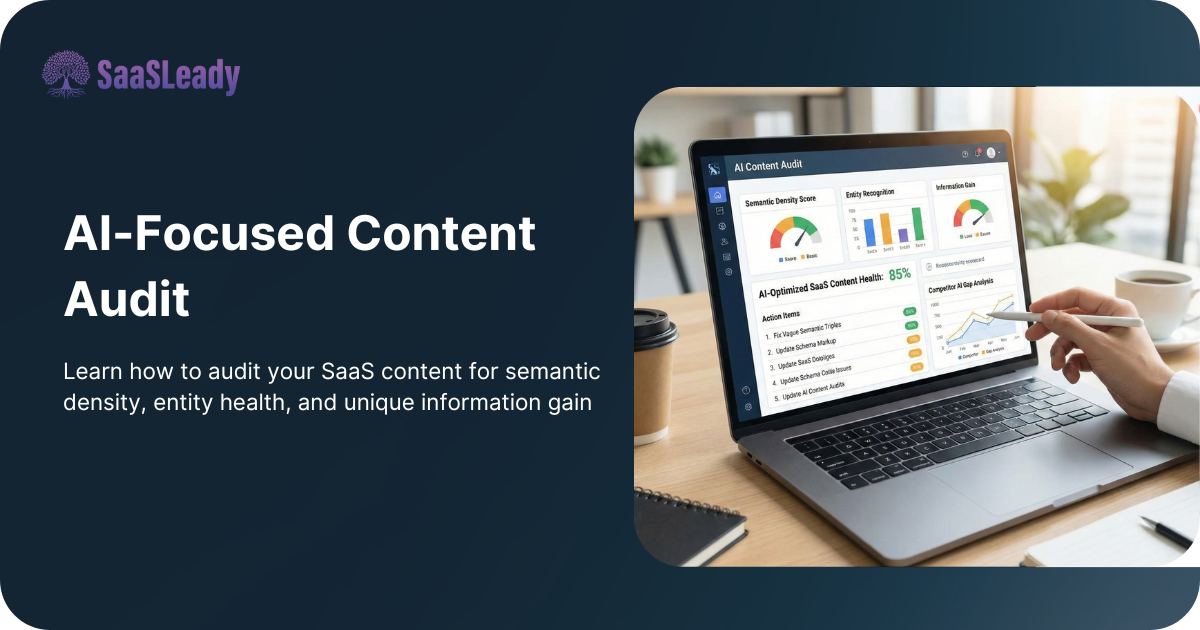
AI-focused content audits secure SaaS citations in LLM responses, directly driving higher-intent leads than traditional search results. In an era where B2B buyers ask ChatGPT to “compare the best CRM for remote teams” instead of scrolling through blue links, ranking #1 is no longer enough; you need to be the answer.
This guide breaks down how to move past legacy SEO tactics to audit your content for semantic density, entity health, and “Information Gain,” ensuring your SaaS becomes the primary reference point for every AI-driven recommendation in your category.
AI-Optimized Content Audits vs. Traditional SEO Audits: Which Strategy Wins?
| Audit Feature | Traditional SEO Focus | AI-Focused (GEO/AEO) Focus |
| Primary Goal | Ranking for specific keywords. | Becoming a trusted “Entity” for a topic. |
| Content Quality | Word count and readability scores. | Information Gain and unique data. |
| Structure | H1, H2, H3 for Google crawlers. | Semantic Triples for LLM extraction. |
| Success Metric | Organic Traffic & SERP Position. | Citations in AI Answers & Branded Search. |
| Technical Requirement | XML Sitemaps & Page Speed. | Schema Markup & LLM “Crawlability.” |
Step 1: Evaluating Semantic Density and Entity Health
To rank in an AI-driven world, your content needs to be “fact-dense.” LLMs look for Semantic Triples, simple subject-predicate-object sentences that define a clear relationship. For example: “SaaS attribution models identify high-conversion touchpoints across the customer journey.” This sentence is a goldmine for an AI because it’s a verifiable fact, it can “learn” and then repeat to a user.
During this stage of the audit, you aren’t just checking for typos. You are looking for “fuzzy” language. If your blog post says, “Our software helps you do things better and faster,” you are failing the AI test. You need to replace vague benefits with concrete entity anchors.
Instruction for the audit: Scan your top-performing pages for “Vague Subject” sentences. Replace them with authoritative claims that link your SaaS product (the Subject) to a specific outcome (the Object).
Auditing for “Hidden” Technical Debt in SaaS Documentation
“Thin” content is a silent killer for AI rankings. If your API documentation is sparse or your “Features” pages are just bullet points without context, you’re creating Technical Content Debt.
When a buyer asks Gemini, “How does [Your SaaS] handle multi-currency reporting?” and your documentation is vague, the AI will hallucinate an answer or, worse, recommend a competitor with clearer documentation. You must audit your technical pages to ensure they serve as a “Source of Truth” for AI models. If the AI can’t understand your architecture, it won’t recommend your product.
Also read: How to Build an Internal Link Map That AI Understands
Step 2: Mapping Content to the “AI Buyer’s Journey”
AI-driven buyers use LLMs to evaluate SaaS vendors, making comparative content and use-case specificity the primary drivers of middle-of-funnel conversion. In a traditional funnel, you’d hope a user clicks your “Best CRM” blog post. In an AI funnel, that user is asking ChatGPT, “Which CRM is best for a 10-person remote sales team using Slack?” If your content doesn’t explicitly answer that hyper-specific scenario, you don’t exist to the AI.
During this part of the audit, you need to look at your “Money Pages” through the lens of a prompt. Are you providing the specific details, like seat minimums, specific integrations, or niche use cases, that an AI needs to “match” you to a user’s query?
Instruction for the audit: Review your middle-of-funnel (MOFU) content. Tag every piece by the “Problem-Solution” pair it addresses. If a page is too broad, it won’t be cited in specific AI recommendations.
Identifying Gaps in Middle-of-Funnel (MOFU) Attribution Logic
One of the biggest mistakes in SaaS content is being “feature-heavy” but “result-poor.” Product analytics improves activation by identifying specific drop-off points in the user journey. If your case studies don’t contain these kinds of factual “Semantic Triples,” an LLM can’t verify your success.
Audit your case studies for “Anchor Data.” An AI agent is much more likely to cite a sentence that says, “Our tool reduced churn by 15% for enterprise clients,” than a vague statement like, “Our clients love our intuitive dashboard.” You want to provide the AI with hard facts it can use to build a case for your software.
Also read: How to Monitor AI Mentions of Your SaaS Product
Step 3: Assessing “Crawlability” for LLM Training Clusters
Optimizing technical infrastructure for AI crawlers ensures LLMs accurately categorize your product features and include your SaaS in high-intent recommendations. We often talk about Googlebot, but your audit must now consider bots like GPTBot or CCBot. If your robots.txt is blocking these, or if your site structure is a maze of JavaScript, the AI models won’t have the “fresh” data they need to recommend you over a competitor.
This step is about making sure your site is “scannable” at a data level. You are moving from a “Human-First” reading experience to a “Machine-Legible” one.
Instruction for the audit: Check your robots.txt and server headers to ensure AI agents aren’t being inadvertently blocked. Use a “Text-Only” crawler to see if your core product value is still visible without heavy CSS or JS.
Leveraging JSON-LD for Enhanced SaaS Entity Recognition
Schema markup defines software entities for large language models. Think of Schema (specifically SoftwareApplication or FAQPage) as a “cheat sheet” for the AI. While an LLM can read your blog post, it prefers to read your structured data because it’s unambiguous.
If your pricing page doesn’t have structured data, an AI might hallucinate your costs or skip you entirely when a user asks for “SaaS tools under $50/month.” Your audit should verify that every product page uses JSON-LD to clearly state your price, category, and core features. This reduces the “friction” for an AI trying to understand what you actually sell.
Also read: How to Structure a SaaS Blog Post for AI Overviews
Step 4: Measuring Information Gain and Originality Scores
Information Gain measures the unique factual delta between your content and the existing top 10 search results, a primary signal for AI-driven authority. In the world of AI-generated fluff, the worst thing your SaaS content can be is “average.” If your blog post on “Project Management Tips” says the same thing as every other article on page one, an LLM has no reason to cite you specifically. It will simply summarize the collective “consensus.”
During this audit, you need to look for “Originality Indicators.” Do you have proprietary data? A unique framework? A contrarian take backed by customer results? If you don’t, your content is essentially “AI food”; it will be consumed and summarized without your brand getting the credit.
Instruction for the audit: Grade your top 20 pages on a scale of 1–10 for “Unique Data Points.” If a page scores below a 7, it needs an original quote, a fresh statistic, or a new case study snippet to increase its Information Gain.
Pruning “Generic” Content to Protect Domain Authority
Pruning non-performant, generic content prevents LLMs from diluting your SaaS brand’s topical authority with low-value associations. Every “What is [Industry Term]?” post that doesn’t offer a unique perspective is actually hurting you. It signals to AI models that you are a “generalist” rather than a “specialist.”
Audit your blog for “commodity content.” If a post could have been written by an entry-level freelancer with 10 minutes of research, it’s likely “fluff.” You should either rewrite it with a unique SaaS angle (e.g., “Why [Industry Term] is failing for PLG teams”) or delete it entirely to focus your “Authority Score” on your best work.
Also read: Answer Engine Optimization (AEO): The New SEO for SaaS
Implementation: Tools for the AI-First Content Auditor
When choosing tools for an AI-focused audit, you need to look beyond simple keyword tracking. You need tools that understand Semantics and Entity Extraction.
| Tool Category | Recommended SaaS Tools | Best Use Case |
| Semantic Analysis | MarketMuse, Surfer SEO | Identifying “Topic Gaps” that LLMs expect to see. |
| Entity Health | InLinks, Schema.org Validator | Ensuring your JSON-LD and Schema are machine-readable. |
| Information Gain | Originality.ai, Custom GPTs | Checking if your content is too similar to the “AI Consensus.” |
| AI Visibility | Perplexity (Manual Search) | Verifying if your brand appears in conversational “Compare” prompts. |
Instruction for the writer: Compare these tools based on their ability to provide “Actionable Entities.” A tool that just gives you a list of keywords is no longer enough; you need a tool that tells you which concepts are missing.
Stop Ranking for Keywords and Start Becoming “The Answer”
Auditing your content for the AI era isn’t a one-time task; it’s a fundamental shift in how your SaaS communicates its value to both humans and machines. Most agencies are still playing by the 2020 SEO playbook, focusing on backlinks and keyword density while ignoring the fact that buyers are now asking ChatGPT and Perplexity to make their software decisions for them.
If your content isn’t appearing in these conversational answers, you aren’t just losing traffic; you’re losing your seat at the table during the most critical stage of the buyer’s journey.
Why SaaS Teams Partner with SaaS Leady
SaaS Leady bridges the gap between traditional search visibility and generative engine authority. We don’t just help you “rank”, we help you dominate the “AI Reference Layer” by transforming your existing assets into authoritative data sources that LLMs trust.
- Deep Semantic Re-Engineering: We move beyond keywords to build “Semantic Triples” and entity anchors that ensure your product is the primary recommendation for high-intent prompts.
- Information Gain Strategy: We replace generic “commodity content” with proprietary insights and data-backed claims that give you a measurable “Originality Score” advantage.
- AEO-First Implementation: From JSON-LD optimization to technical bot-accessibility audits, we handle the complex plumbing that makes your site machine-readable.
Turn Your Content into a Growth Engine
Don’t let your competitors define your category in the world of AI. Let’s identify the gaps in your current content strategy and build a roadmap that drives real signups, not just vanity metrics.
[Book a Free AI Content Gap Analysis with SaaS Leady]
The “AI-Ready” Content Audit Checklist
Structured data implementation increases AI citation rates by providing unambiguous product specifications. Before you start deleting pages or rewriting your entire blog, use this checklist to see where you actually stand. It’s designed to help you move from “maybe we’ll rank” to “the AI will find us.”
Phase 1: Semantic & Entity Health
- [ ] Identify “Fuzzy” Language: Scan your top 10 pages for vague claims (e.g., “We offer the best solution”). Replace them with at least three Semantic Triples per page (e.g., “[Product Name] automates [Task] for [User Persona]”).
- [ ] Verify Entity Anchors: Ensure your brand name is consistently associated with your primary category (e.g., “SaaS Attribution Tool”) across your Home, About, and Product pages.
- [ ] Audit for Comparison Readiness: Search for “[Your SaaS] vs [Top Competitor]” in Perplexity. If the AI can’t list three distinct advantages for you, create a dedicated comparison page immediately.
Phase 2: Technical “Bot” Access
- [ ] Check Robots.txt: Ensure you aren’t accidentally blocking GPTBot, CCBot, or PerplexityBot. If you want to be cited, you have to let them in.
- [ ] Validate JSON-LD: Run your pricing and feature pages through the Schema.org Validator. Specifically, check for SoftwareApplication, Offer, and FAQPage properties.
- [ ] Test “Text-Only” Legibility: Use a tool like the “Disable HTML” extension to see if your core value proposition is still readable when CSS and JavaScript are stripped away. This is how many LLM crawlers see your site.
Phase 3: Information Gain & Pruning
- [ ] Calculate the “Delta”: For your top-performing guides, identify one piece of proprietary data or one “contrarian” insight that isn’t present in the current Google Top 10.
- [ ] Execute the “Fluff” Pruning: Identify “What is [Industry Term]?” posts with high bounce rates and low conversions. Either add a unique SaaS-specific case study to them or 301 redirect them to a more authoritative product page.
- [ ] Audit for Source Citation: Check if your original research or data points are being cited by others. If not, add a “TL;DR” summary box at the top of data-heavy posts to make it easier for LLMs to extract and credit your facts.