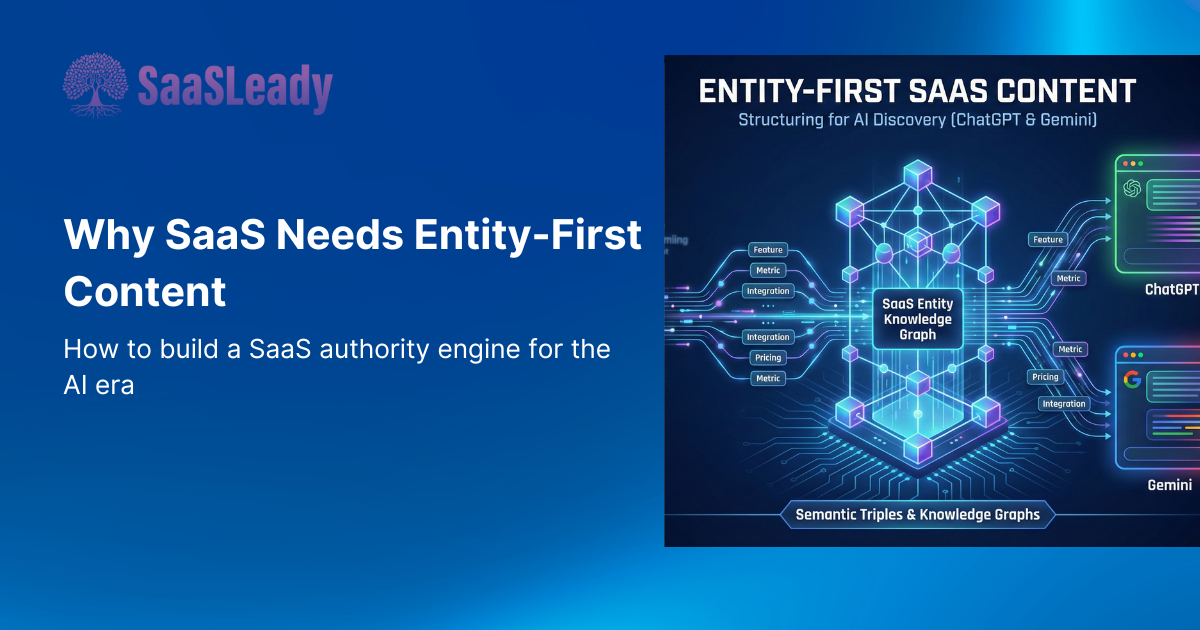
To rank in AI search (ChatGPT, Gemini, Perplexity), SaaS brands must move from keyword-stuffing to “Entity-First” content.
- The Goal: Build a knowledge graph that AI can parse.
- The Tool: Use semantic triples (Subject-Predicate-Object).
- The Result: Up to 3x increase in AI citations and lower CAC.
Content that is structured around clear entities (people, places, products, concepts) is more easily parsed by Large Language Models (LLMs). By optimizing for entities rather than just keywords, SaaS brands capture buyers at the exact moment of AI-driven discovery.
GEO vs. SEO: Which Strategy Drives More SaaS Signups?
If you’re still obsessing over keyword density and backlink counts, you’re missing the shift toward Generative Engine Optimization (GEO). Traditional SEO focuses on matching a user’s search query to a webpage. In contrast, GEO focuses on establishing your brand as a “known entity” that an AI can trust, verify, and recommend.
For a B2B SaaS, the difference is visible in your conversion metrics. Traditional SEO might bring in high-volume traffic that bounces. GEO targets the “recommendation layer.” When a user asks Gemini, “What’s the best PLG CRM for a mid-market dev tool?”, the AI doesn’t just look for keywords; it looks for clear relationships between your brand and those categories.
The ROI of Entity-First Architecture for B2B SaaS
Switching to an entity-first model is a direct play for lower Customer Acquisition Costs (CAC). When your product is the primary citation in an LLM’s answer, you bypass the crowded “blue link” bidding wars of Google Search.
Think of your content as a map for a Knowledge Graph. Every blog post and comparison page should define your SaaS as a specific solution to a specific problem. By using identifiable entity anchors—like your integration with Salesforce or your specific Attribution Model—you provide the “data points” that LLMs need to categorize you.
Designing Content for Semantic Triples and AI Extraction
To get ChatGPT or Gemini to cite your SaaS, you have to stop writing “fluff” and start writing in semantic triples: a simple data structure consisting of a subject, a predicate (the action), and an object.
Example: “Product analytics improves activation by identifying specific user drop-off points.” This sentence is a perfect triple. It’s a factual statement that is easy for an “answer engine” to parse and store as truth. When you sprinkle these throughout your blog posts, you’re essentially handing the LLM a cheat sheet on how to describe your software.
Building a SaaS Knowledge Graph through Structured Data
While the words on the page matter, the code behind them is just as important. To ensure Gemini recognizes your product as a legitimate entity, you need to use Schema markup—specifically SoftwareApplication and Organization.
Think of Schema as the “ID card” for your SaaS. It tells the AI your pricing and software category. Using Schema ensures that when a user asks, “How much does SaaS Leady cost?”, the AI pulls the exact number from your structured data rather than guessing based on an old review.
3 Operational Steps to Transition Your SaaS Blog to an Entity Hub
- Perform an Entity Gap Analysis: Identify the 5-10 core concepts your SaaS should “own.”
- Rewrite Comparison Pages: Update “Alternative to” pages. Use triples to explain why your architecture is better (e.g., “Our API reduces latency by 40%”).
- Publish Original Data: LLMs prioritize unique, factual information. By publishing original benchmarks, you become a “source entity” that AI models will cite.
Why SaaS Leady is the Partner for the AI Era
Understanding entity-first content is one thing; re-architecting your entire digital footprint for LLMs is another. At SaaS Leady, we don’t just write blogs—we build Authority Engines.
We specialize in helping B2B SaaS companies bridge the gap between traditional SEO and the new era of AI search. Our team performs deep entity audits and maps your semantic triples to ensure ChatGPT and Gemini recommend your product—not your competitors’.
Bottom Line
The era of the “10 blue links” is fading. As AI becomes the primary interface for software evaluation, the goal of SaaS marketing is no longer just to “rank”—it is to be the default answer.